Search results
551
[Page extract]
How is top-load testing performed?
Equipment and setup
The essential equipment for a top-load test includes:
552
[Page extract]
Key methods of penetration resistance testing
Penetration resistance measures a material’s ability to resist intrusion by a probe or object under applied force without tearing, cracking, or losing functional integrity.
Applications include:
553
[Page extract]
The process of tension testing
Tension testing follows a defined process to ensure accuracy and repeatability:
554
[Page extract]
Types of flexure tests
Different flexure testing setups are chosen based on the nature of the material, the required precision, and the industry standards being followed.
555
[Page extract]
What is bulk analysis testing?
Definition and purpose
Bulk analysis testing assesses the mechanical properties of particulate materials as a collective whole, rather than analysing individual particles. This includes powders, granules, pellets and similar materials.
556
[Page extract]
How to perform a breaking torque test
Required equipment and setup
Mecmesin offers a range of torque testing systems suited to different torque capacities and application requir
557
[Page extract]
Strip Torque
Strip torque testing is a specialised method used to evaluate the performance and safety of threaded closures and connectors in packaging, medic
558
[Page extract]
Applications in advanced ceramics and composites
Four-point bend testing is the preferred approach for assessing the flexural strength of advanced ceramics<
559

Case study
Wall-mounted air freshener destructive loading evaluation
Requirement
The customer wished to apply a controlled load of 350N to a wall mounted air freshener, replicating the effect of a child standing on it. The load needed to be applied in turn to 4 different planes on the product, e.g.
560
[Page extract]
Standards for compressive hardness testing
Internationally recognised standards ensure that compressive hardness tests are accurate, repeatable, and comparable.
561
[Page extract]
Analysis and interpretation of results
Interpreting shear failure characteristics
Post-test examination of the bonded joint provides valuable insight into adhesive performance:
563
Case study
Child safety - force to extract lighter
Requirement
The customer manufactures lighters and is currently developing a case/guard designed to increase the safety for children.
564

Event
Medical Device Testing: Needle sharpness and syringe actuation testing (with 21 CFR Part 11 compliance)
Hypodermic needles are tested to determine their efficacy in piercing elastomer closures on vials and how their design influences the ease of insertion into the patient's skin, influencing pain and skin trauma.
The smooth and consistent operat
565
Case study
Luer lock fastening and release torque
Customised engineering example
Luer lock test standards frequently call for measuring torque whilst simultaneously applying a pre-defined axial force.
566

Event
Tensile Testing for Wiring Harness Connections
The only way of really knowing the strength of a crimped terminal is to pull it. This can reveal production problems, where strand nicks, incorrect crimp height, or effects from changes in terminal supply, may not be clearly apparent.
567

Event
Tensile Testing for Wiring Harness Connections
The only way of really knowing the strength of a crimped terminal is to pull it. This can reveal production problems, where strand nicks, incorrect crimp height, or effects from changes in terminal supply, may not be clearly apparent.
568

Event
T-Peel (Adhesion Strength) Testing
This webinar will focus on the most common approach to measuring the adhesion strength of two materials bonded together with an adherent.
569
[Page extract]
TAPPI T 824 standard
Overview of the standard
TAPPI T 824 is the internationally recognised standard that specifies the procedures, equipment requirements, and specimen preparation methods for conducting
570
Case study
Peel testing identity cards
Requirement
The customer produces identity cards with a laminated cover. The customer wanted to know that the adhesive used to bond the laminate and card together was strong enough to withstand a high rate of day-to-day usage.
571

Event
Materials Testing: Theory and Practice Pt. 2
Materials testing is often the last step in the manufacturing process. Yet, quality is the result of both the process and the material. If the material that goes into the product is inadequate or defective, then the product may be deficient or faulty.
572
Case study
Medical sharps bin puncture resistance
Customised engineering example
International standards (ASTM F2132, BS 7320, BS 23907) specify the puncture resistance of medical sharps containers.
573
Case study
Removal torque of 'squeeze and twist' child-resistant cap
Requirement
Reckitt-Benckiser are manufacturers of the distinctive HDPE (High Density Polyethylene) swan-neck 'Harpic' cleaning fluid bottles.
574
Case study
Elongation test of infusion solution bag
Requirement
Fresenius Kabi is a global manufacturer of pharmaceutical products and delivery systems for infusion therapies and clinical nutrition.
575
Event
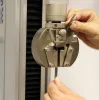
Essentials of GRIP & FIXTURE Selection in Force & Torque Testing Webinar
When physically testing a material or component, the ability to apply load to a test specimen is important—but having the ability to apply that load correctly is just as crucial.