Search results
1251

Event
Live Demonstration: Wire Crimp Tensile Testing
Wire crimp tensile testing provides confidence in the integrity and performance of crimped connections, ensuring reliability, safety, and compliance with industry standards.
1252
[Page extract]
Standards and guidelines for torque testing
Overview of ASTM and CETIE standards
Standardised testing ensures consistency and compliance. Commonly followed guidelines include:
1253
[Page extract]
ASTM D3481
This test method covers the measurement of the force required to separate (or “shell”) the snap-fitted outer cap from the inner cap of Type IA, IB, or IC child-resistant closures.
1254
[Page extract]
Standards for insertion and withdrawal testing
Adhering to industry standards ensures consistency, repeatability, and compliance. Key standards include:
1255
[Page extract]
ASTM D882-18
ASTM D882 is a test method that covers the determination of tensile properties of plastics in the form of thin sheeting and films (less than 1.0 mm (0.04 in.) in thickness). It is used to measure tensile properties including ultimate tensile
1256
[Page extract]
Why Mecmesin for closure torque testing
Precision torque measurement systems
Mecmesin offers high-resolution torque testers such as the OmniTest and
1257
[Page extract]
ASTM F2592
1.1 This test method covers the measurement of force displacement characteristics of a membrane switch.
1258
[Page extract]
What is the grab method?
The grab method is a tensile testing technique where only the centre of a fabric specimen is gripped during testing — typically using 100 mm × 150 mm test specimens with a 50 mm wide clamp
1259
[Page extract]
BS 7907
BS 7907 gives recommendations for the design and manufacture of children’s clothing to promote mechanical safety. This standard is applicable to clothing intended for children up to 14 years of age.
1260
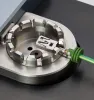
Event
Wire Terminal Strength & Crimp Testing Webinar
The only way of really knowing the strength of a crimped terminal is to pull it.
1261
[Page extract]
Standards for texture compression testing
ISO 16305 - Butter firmness
Specifies a method for determining butter firmness under controlled conditions.
1262
[Page extract]
Standards for box crush testing
ASTM D642-00
This standard specifies methods for determining the compressive resistance of shipping containers, both filled and empty.
1263
[Page extract]
ASTM D3165
This test method is useful in that the joint configuration closely simulates the actual joint configuration of many bonded assemblies.
1264
[Page extract]
ASTM F2458-05
This test method covers a means for comparison of wound closure strength of tissue adhesives used to help secure the apposition of soft tissue.
1265
[Page extract]
Why is the 90-degree peel test important?
Adhesion is fundamental in industries such as packaging, automotive, constructi
1266
[Page extract]
BS EN ISO 71-2
BS EN 71-2 covers the flammable materials which are prohibited in all toys and the requirements concerning flammability of certain toys when exposed to fire.
1267
[Page extract]
ASTM D2979
This test method covers measurement of the pressure-sensitive tack of adhesives.
1268
[Page extract]
BS EN 12209
BS EN 12209:2016 specifies requirements and test methods for the durability, strength, security, and function of mechanically operated locks and latches and their locking plates for use in doors, window doors and entrance doors in buildings.
1269
[Page extract]
Methods for measuring coefficient of friction
The most widely adopted technique for measuring both static and kinetic coefficients of friction (COF) is the hori
1270
Page
You have been subscribed to the Mecmesin newsletter
Thank you
We hope you enjoy the regular updates on our developments in force, materials and torque testing.
1271
[Page extract]
ASTM F1306
ASTM F1306, is a test method, which permits flexible barrier films and laminates to be characterised for slow rate penetration resistance to a driven probe.
1272
[Page extract]
BS EN ISO 4624
Describes methods for determining the adhesion by carrying out a pull-off test on a single coating or a multi-coat system of paint, varnish or related product.
1273
[Page extract]
What is the 90-degree peel test?
The 90-degree peel test is a mechanical method used to measure the adhesive strength between two bonded materials.
1274
Page
Missing link
The page you requested wasn't found on this site. It could have moved or something has gone wrong.
1275
[Page extract]
Understanding peel resistance
Peel resistance is the force required to separate two bonded surfaces through a peeling motion. This force is measured using a tensile test system equipped with a peel fixture.