Search results
601

Case study
Synthetic sports surface tuft binding
Customised engineering example
Test method standard BS ISO 4919 applies to the tuft withdrawal force of carpets.
602
Case study
Box-forming and edge crush strength of cartons
Customised engineering example
The Box Crush Test (BCT) is commonly used to assess the effect of applying an axial top-load force upon the flat sides of carton boxes to simulate stacking them in a warehouse or during transportation.
603
Case study
Train door safety override testing
Customised engineering example
A UK train operator needed a method of testing how sensitive are the carriage sliding doors to detecting an obstacle when closing or opening.
604
[Page extract]
ASTM D6241-04
This test method for determining the puncture strength of geotextiles is to be used by the industry as an index of puncture strength.
605
Case study
Cost effective cable strength testing
Customised engineering example
A major manufacturer of wire harnesses and connectors approached us for a cost-effective solution to pull-force test cables with different diameters having direct-bonded joints.
606
Event
Wire Crimp & Weld Testing Webinar
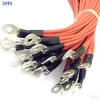
The only way of really knowing the strength of a crimped terminal is to pull it.
607

Event
Live Demonstration: Wire Crimp Tensile Testing
Wire crimp tensile testing provides confidence in the integrity and performance of crimped connections, ensuring reliability, safety, and compliance with industry standards.
608
Event
Fundamentals of Compression Testing
How much force is required to register a command when you click your computer mouse?
How much force can a water bottle take before it collapses in its case under a stack?
609

Event
Fundamentals of Compression Testing
How much force is required to register a command when you click your computer mouse?
How much force can a water bottle take before it collapses in its case under a stack?
610

Event
Tensile Testing: Extension, Elongation, Force & Failure
The primary objective for measuring and analyzing the the tensile force value of a product is to accurately determine one or more of these factors:
611

Event
Understanding Top-Load Testing - Live Application Demo
Packaging manufacturers use top-load or crush testing to ensure packaging integrity, and to eliminate material excess while maintaining quality.
612
Case study
Child resistant closures (CRC) mandrel
Customised engineering example
Child Resistant Closures (CRC) require sufficient vertical force to activate the CR locking mechanism prior to torque being applied.
613
Test Frame
Vortex test frame
Vortex test frame
A sturdy twin-column test frame capable of applying torque up to 10 N.m (90 lbf.in). Tall and wide enough to accept a variety of test specimens yet compact to use as a bench-top tester.
View test frame
614
[Page extract]
Loop tack test procedure
Sample preparation
Cut adhesive strips to the required length and width stated in the chosen standard. Condition the samples at the specified temperature and humidity before testing.
615
[Page extract]
How is double lap shear testing performed?
Specimen preparation
Specimens are prepared according to standardised dimensions.
616
[Page extract]
Standards for tension testing
Key standards
ISO 527 - Tensile testing of plastics, covering tensile strength, modulus and elongation
AS
617
[Page extract]
Test setup and equipment
Performing lap shear testing under compression requires careful alignment and use of appropriate fixtures to prevent torsion or uneven load distribution.
618
[Page extract]
Understanding cone penetration testing
Cone penetration testing is a precision method used to determine a material's resistance to penetration by a standardised cone-shaped probe under specific force conditions.
619
[Page extract]
Procedure for tensile testing
While the specifics vary depending on material type and applicable standards, the general procedure includes:
620
[Page extract]
Key standards in tear testing
Compliance with recognised testing standards ensures that results are accurate, repeatable, and comparable across laboratories and production sites. Mecmesin tear testers are designed to meet or exceed major industry requirements.
621
[Page extract]
Why choose Mecmesin for flat crush testing
Mecmesin provides precision-engineered flat crush testing solutions designed for accuracy, repeatability, and compliance with ISO, TAPPI, and FEFCO standards.
622
[Page extract]
Why Mecmesin for reverse ratchet torque testing
Mecmesin offers torque testing systems engineered to meet the precise demands of child-resistant closure
623
[Page extract]
Understanding test standards: industry-specific requirements
To maintain consistency and reliability, compressive strength tests are often governed by established standards.
624
[Page extract]
Standards and compliance for torque testing
Key standards
ASTM D2063 - Specifies torque retention testing for thread closure
625
[Page extract]
Testing equipment and techniques
Mandrels
Custom-designed mandrels ensure closures are aligned and secured during testing. Correct mandrel design prevents slippage and eliminates fixture-induced variability.