Search results
1326
[Page extract]
Introduction to friction in material science
Friction is a critical factor in how materials behave under movement. It is the resistive force that occurs when two surfaces are in contact and attempt to slide against each other.
1327
[Page extract]
Standards and compliance
International standards ensure penetration and puncture testing is performed consistently for reliable and comparable results.
Key examples include:
1328
[Page extract]
Step-by-step test methodology
Preparation
Sample selection - Choose representative specimens, avoiding faults unless deliberately testing them.
Specimen cutting - Cut to standard dimensions with a central slit of specified
1329
[Page extract]
Introduction to the ring crush test
The ring crush test (RCT) is a key method for determining the edgewise compression strength of paper and paperboard.
1330
[Page extract]
Understanding reverse ratchet torque
Reverse ratchet torque testing is an essential process for verifying the safety and reliability of child-resistant closures (CRCs).
1331
[Page extract]
Introduction to flexural testing
Flexural testing is a core method in materials science, used to evaluate how materials perform when subjected to bending stresses.
1332
[Page extract]
How running torque is measured
Running torque is typically measured using precision torque sensors mounted within a controlled test stand. The component under test is rotated at a defined speed, and torque is measured continuously during motion.
1333
[Page extract]
Test setup and equipment
Performing lap shear testing under compression requires careful alignment and use of appropriate fixtures to prevent torsion or uneven load distribution.
1334
[Page extract]
Understanding cone penetration testing
Cone penetration testing is a precision method used to determine a material's resistance to penetration by a standardised cone-shaped probe under specific force conditions.
1335
[Page extract]
Understanding tear strength and its importance
Tear strength measures the force a material can withstand before a tear propagates. It covers both the initial rupture and the resistance to further tearing once damage has started.
1336
[Page extract]
Interpreting breakaway test results
Understanding test outputs is as crucial as conducting the tests themselves.
Slip torque vs bridge torque
Slip torque reflects the resistance encountered before rotation begins—a measure of seal integrity and usability.
1337
[Page extract]
Standards and compliance
ASTM D2063 defines methods for determining application and r
1338
[Page extract]
Understanding ASTM D2718 standards
The ASTM D2718 standard sets out the procedures for conducting planar shear tests on structural panels using the
1339
[Page extract]
The concentric ring method
The most widely used approach to equibiaxial flexure compression testing is the concentric ring method. A circular specimen is supported on an outer ring and loaded through a smaller, concentric inner ring.
1340
[Page extract]
Standards and protocols
Notable standards and specifications
Several international standards define single lap shear testing methods:
1341
[Page extract]
The science behind chord modulus
Definition and importance
Chord modulus is determined by drawing a straight line, known as the chord, between two points on the stress-strain curve.
1342
[Page extract]
What is strip torque testing?
Definition and importance
Strip torque testing measures the torque required to continue rotating a threaded closure beyond its normal sealing point until the thread strips or the closure fails.
1343
[Page extract]
BS EN ISO 80369-20
These standards describes the methods for testing the performance of 6% Luer lock fittings including assembly, leak tightness, stress cracking, and separation force.
1344
[Page extract]
ASTM D6241-04
This test method for determining the puncture strength of geotextiles is to be used by the industry as an index of puncture strength.
1345

Event
Medical Devices: Syringe & Needle Testing Fundamentals
Every manufacturer (and patient) requires reliable needle and syringe function - ensuring safe & efficient drug administration.
Therefore, checking the performance and functionality of these medical devices is critical, with physical testi
1346
[Page extract]
BS EN ISO 80369-7
This part of ISO 80369 specifies dimensions and requirements for the design and functional performance of small-bore connectors intended to be used for connections in intravascular applications or hypodermic connections in hypodermic applications of med
1347
[Page extract]
ASTM F1306
ASTM F1306, is a test method, which permits flexible barrier films and laminates to be characterised for slow rate penetration resistance to a driven probe.
1348
Event
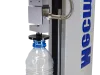
Compression Testing in Top Load Applications
A typical challenge in packaging, and bottling applications is trying to balance product integrity, where the container might be too weak and crush under load, and excessive raw material cost, where the container is too strong.
1349
Event
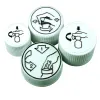
Child Resistant Closure Testing
Medical, Pharmaceutical and Chemical Packaging takes product safety seriously.
1350
[Page extract]
ISO 11608-5
This part of ISO 11608 specifies requirements and test methods for the automated functions of needle-based injection systems with automated functions (NIS-AUTO), for the administration of medicinal products in humans.