Search results
1676
[Page extract]
ASTM D1566
ASTM D1566 is a source of reference for definitions of technical terms used in the rubber industry
Standards can be obtained from appropriate standard authorities.
1677
[Page extract]
BS EN ISO 13262
BS EN ISO 13262 is test method to determine the tensile strength of seams on thermoplastics spirally-formed structured-wall pipes.
1678
[Page extract]
BS EN 12562
Synthetic fibres, Polyamide fibres, Aramide fibres, Textile products, Textile testing, Yarn, Filament yarns, Filaments, Filament (textile fibre), Yarn testing, Yarn linear density determination, Elongation at fracture, Elongation, Force measurement, Mec
1679
[Page extract]
BS EN ISO 22088-2
BS EN ISO 22088-2 is a test method for determining the environmental stress cracking of plastics.
This has replaced BS EN ISO 6252:1998
1680

Event
Webinar: Rice Texture Analyzer (Thai) - เทคโนโลยีเครื่องมือวัด และมาตรฐานการทดสอบข้าว
เทคโนโลยีเครื่องมือวัด และมาตรฐานการทดสอบข้าว
หนึ่งในปัจจัยที่สําคัญที่สุด ซึ่งมีผลต่อความสำเร็จของผลิตภัณฑ์ข้าวคือ เนื้อสัมผัส
เนื้อสัมผัสของข้าวส่งผลโดยตรงต่อความพึงพอใจของผู้บริโภค และความน่าเชื่อถือของผู้ผลิตข้าว นั่นคือเหตุผลว่า
1681
[Page extract]
ISO 12625-5
ISO 12625-5:2005 specifies a test method for the determination of the wet tensile strength of tissue paper and tissue products after soaking with water, using a tensile-strength-testing apparatus operating with a constant rate of elongation.
1682
[Page extract]
ANSI/EIA 364
Mating and Unmating Procedure for Force Testing of Electrical Connectors and Sockets
1683
[Page extract]
BS EN ISO 10618
Carbon fibres, Mechanical properties of materials, Tensile strength, Tensile testing, Plastics, Impregnated materials, Yarn, Modulus of elasticity, Strain, Tensile strain, Loading, Reinforcing materials, Composite materials, Test equipment, Test specime
1684
[Page extract]
BS ISO 6133
BS ISO 6133 specifies five methods of calculating, after testing, the tear strength and the adhesion strength of vulcanized rubber or fabrics coated with or adhered to rubber or plastics.
1685

Event
Medical Devices: General testing with 21 CFR Part 11 compliance
Reliable results, trusted compliance: 21 CFR Part 11's role in securing medical device quality testing.
Quality testing of Medical Devices ranges from syringe actuation (break loose and glide), needle sharpness and adhesion strength to Child R
1686
[Page extract]
Belt/strap grips
Belt and strap grips - typically of a split-roller type in order to provide a rounded, smooth-surface around which a belt or strap can be looped several times.
1687

Event
Fundamentals of Adhesion (Peel) Testing
There is a reason people reach for Duct Tape as a fix for almost everything – Adhesion Strength. From busted pipes to ripped furniture, the preference for a solution that “does not easily peel off” is the guiding principle for manufactures.
1688
Event
Packaging: Edge Crush & Carton Crush testing
The Edge Crush Test (ECT) and Carton Crush Test (CCT) are codified international test methodology. They are used in the packaging industry to assess the strength and durability of corrugated boxes or paperboard materials and others.
1689
[Page extract]
CETIE Guide 9
This guide applies to the screw capping of pressurised wines & other beverages for narrow necks finishes with a redrawn metallic tamper-evident closure on a "BVS type" glass finish adapted for pressure caps. Includes sections on checking load setting on
1690
[Page extract]
ASTM C1341
This test method covers the determination of flexural properties of continuous fiber-reinforced ceramic composites in the form of rectangular bars formed directly or cut from sheets, plates, or molded shapes.
1691
Event
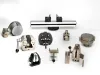
Webinar: Master Grips & Fixtures for Consistent Testing
When physically testing a material or component, the ability to apply load to a test specimen is important—but having the ability to apply that load correctly is just as crucial.
1692
[Page extract]
BS EN ISO 10591
This International Standard specifies a method for the determination of the influence of water on the adhesion cohesion properties of sealants with predominantly plastic behaviour which are used in joints in building construction.
1693
[Page extract]
Jaws
Choosing the most appropriate jaw type for a tensile grip can be tricky. It is a balance between having sufficient hold of the specimen to prevent it slipping and not having too ‘aggressive’ a hold which damages the specimen.
1694
[Page extract]
TAPPI T 824
This test evaluates the ability of corrugating medium to contribute to the compression strength of a corrugated box.
1695
[Page extract]
ASTM D3166
This test method covers the measurement of fatigue strength in shear by tension loading of adhesives on a standard specimen and under specified conditions of preparation, loading, and testing.
1696
[Page extract]
ASTM D5379/D5379M-05
This test method covers the shear properties of composite materials reinforced by high-modulus fibers. The composite materials are limited to continuous-fiber or discontinuous-fiber-reinforced composites in specific forms.
1697
[Page extract]
ASTM D3846
ASTM D3486 is a test method used for evaluating the in-plane strength of reinforced thermosetting plastics in flat sheet form in thicknesses ranging from 2.54 to 6.60 mm.
1698
[Page extract]
ASTM D1894
This test method is used to measure the friction of plastic film and sheeting. It determines the kinetic (moving) and static (starting) resistance of one surface being dragged across another.
1699
[Page extract]
ASTM D2261
This test method covers the measurement of the tearing strength of textile fabrics by the tongue (single rip) procedure using a recording constant-rate-of-extension-type (CRE) tensile testing machine.
1700
[Page extract]
ASTM E2658-15
These practices cover procedures and requirements for the calibration and verification of testing machine speed by means of standards calibration devices