Search results
1576
[Page extract]
BS EN 12814-6
BS EN 12814-6 is a low temperature tensile test method for testing welded joints of thermoplastics semi-finished products.
1577
[Page extract]
ASTM D7249-12
This test method covers determination of facing properties of flat sandwich constructions subjected to flexure in such a manner that the applied moments produce curvature of the sandwich facing planes and result in compressive and tensile forces in the
1578
[Page extract]
BS EN ISO 10066
BS EN ISO 10066 is a test method for determining creep in tension of flexible cellular polymeric materials.
1579
[Page extract]
SAE J174
This test procedure is intended to provide a quality control method for checking torque-tension characteristics of non-prevailing torque type threaded steel fasteners 1/4 through 1 in nomial diameters.
1580
[Page extract]
ISO 9073-3
Application of a force longitudinally to a test piece of a specified length and width at a constant rate of extension. Determination of values for breaking strength and elongation from the recorded force-elongation curve.
1581
[Page extract]
ASTM D4776 / D4776M-18
ASTM D4776 is a test method used to determine the maximum adhesion force of tyre cords in rubber compounds.
1582
[Page extract]
BS 4863
Gives safety requirements for playpens for use by children up to 15kg in weight. It covers both rigid sided and mesh sided playpens.
1583
[Page extract]
ASTM D6117-18
ASTM D6117 covers the evaluation of fastener use with “as manufactured” plastic lumber and shapes through the use of two different testing procedures:
1584
[Page extract]
ASTM D3410 / D3410M
ASTM D3410 determines the compressive properties of polymer matrix composite materials reinforced by high-modulus fibers.
1585
[Page extract]
ISBT PTC-00019
This document provides a collection of test methods for the qualification of plastic flat-top closures applied on PET bottles that are used in the beverage industry.
1586
[Page extract]
ASTM D876 - 13
ASTM D876 is a test method covering the testing of general-purpose (Grade A), low-temperature (Grade B), and high-temperature (Grade C)2 non-rigid vinyl chloride polymer tubing, or its copolymers with other materials, for use as electrical insulation.

1588
[Page extract]
ASTM D2718
These test methods determine the shear properties of structural panels associated with shear distortion of the planes parallel to the edge planes of the panels. Both shear strength and modulus of rigidity may be determined.
1589
[Page extract]
BS EN 843-1
EN843-1 describes methods for determining the nominal flexural strength of advanced monolithic technical ceramic materials at ambient temperature.
1590
[Page extract]
ASTM D5934-02
ASTM D5934 specifies the use of controlled rate of loading mechanical instrumentation on rectangular plastic bars molded directly or cut from sheets, plates, or molded shapes via three-point loading bending techniques to obtain material properties such
1591
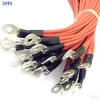
Event
Wire Crimp & Weld Testing Webinar
The only way of really knowing the strength of a crimped terminal is to pull it.
1592
[Page extract]
ASTM D1876
This test method measures the peel separation strength of two flexible materials that have been bonded together.
1593

Event
Webinar: Adhesion/Peel strength testing
There is a reason people reach for duct tape as a fix for almost everything – adhesion strength.
From busted pipes to ripped furniture, the preference for a solution that “does not easily peel off” is the guiding principle for manufacturers.
1594
[Page extract]
ASTM C674
These test methods cover determination of the modulus of rupture and the modulus of elasticity of fired ceramic whitewares bodies, formed by any fabrication method, and are applicable to both glazed and unglazed test specimens.
1595
[Page extract]
ASTM D1894
This test method is used to measure the friction of plastic film and sheeting. It determines the kinetic (moving) and static (starting) resistance of one surface being dragged across another.
1596
[Page extract]
BS 1726-1
Provides guidance on methods of specifying and tolerancing hot coiled compression springs, and cold coiled springs that fall outside the size range limits specified in BS EN 15800.
1597
[Page extract]
ISO 11608-5
This part of ISO 11608 specifies requirements and test methods for the automated functions of needle-based injection systems with automated functions (NIS-AUTO), for the administration of medicinal products in humans.
1599
[Page extract]
ISO 12625-4
Specifies a test method for the determination of the tensile strength, stretch at break and tensile energy absorption of tissue paper and tissue products. It uses a tensile-testing apparatus operating with a constant rate of elongation.
1600
[Page extract]
ASTM D1623
ASTM D1623 determines the tensile and tensile adhesion properties of rigid cellular plastics materials and foam. These are often used as insulation and structural materials in the aerospace, automotive and construction industries.