Search results
2201
[Page extract]
ISO 6237
Specifies a method for determining the shear strength of wood-to-wood adhesive bonds, with a standard specimen loaded in tension and under specified conditions of preparation, conditioning and testing.
2202
[Page extract]
ASTM D6068-10
This test method covers the determination of the J-integral versus crack growth resistance (J-R) curves for polymeric materials.
2203
[Page extract]
ASTM D3574
ASTM D3574 is a test method used for testing soft polyurethane foam used in car seats, mattresses, pillows and other foam products. Samples come in a variety of forms including slab, bonded, and molded flexible cellular urethane foams.
2204
[Page extract]
ASTM D3106
This test method covers the determination of the permanent deformation of bare, continuous elastomeric monofilaments and filament yarns made from rubber, spandex, anidex, or other elastomers subjected to prolonged periods of tension.
2205
[Page extract]
ISO 1827
ISO 1827 specifies methods for the determination of the modulus in shear and the strength of bonds of rubber to metal or other rigid plates, using rubber bonded between four parallel plates.
2206
[Page extract]
ASTM F543-13
This specification provides requirements for materials, finish and marking, care and handling, and the acceptable dimensions and tolerances for metallic bone screws that are implanted into bone.
2207
[Page extract]
ISO 505
ISO 505 specifies a method of test for the measurement of the propagation resistance of an initial tear in textile conveyor belts, either in full thickness or of the carcass only.
2208
[Page extract]
ASTM F628-12e3
This specification covers coextruded acrylonitrile-butadiene-styrene (ABS) plastic drain, waste, and vent pipes made to Schedule 40 iron pipe sizes (IPS) with concentric inner and outer solid ABS layers and a closed-cell cellular ABS core.
2209
[Page extract]
BS 2782-12: 1210A to C
BS 2782-12: Method 1210A to C specifies a test method for testing the longitudinal tensile properties of glass-reinforced thermosetting plastics (GRP) pipes.
2211
[Page extract]
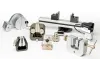
FINAT FTM3
This test method allows the end user to determine the force required to separate the release backing from the pressure sensitive adhesive coated face material.
2213
[Page extract]
ASTM D3410 / D3410M
ASTM D3410 determines the compressive properties of polymer matrix composite materials reinforced by high-modulus fibers.
2214
[Page extract]
ASTM D3916
ASTM D3916 is a test method for determining the tensile properties of pultruded, glass-fiber-reinforced thermosetting plastic rod of diameters ranging from 3.2 mm to 25.4 mm.
2215
[Page extract]
PSTC 131
SCOPE
1.1 The procedures in this test method describe the measurement of breaking strength, elongation
at break, and energy to break, of pressure sensitive tapes.
2216
[Page extract]
ASTM D2339
By the nature of the way adhesives are used in two-ply wood construction, shear strength is an important performance criteria.
2217
[Page extract]
ISO 37
ISO 37 specifies a method for the determination of the tensile stress-strain properties of vulcanized and thermoplastic rubbers.
This test standard is equivalent to BS ISO 37.
2218

Event
Packaging: Peel & Adhesion testing
Adhesion strength is a key factor in packaging, providing reliability and durability for a wide range of products.
Whether it's ensuring that a shipping box remains sealed during transit or that labels stay firmly attached to containers, the a
2219

Event
Fundamentals of Texture Testing Analysis
The primary goal for using instrumentation to measure texture is to capture an objective value to something that is typically evaluated very subjectively. Texture cannot be controlled unless it measured in a consistent and repeatable manner.
2220
[Page extract]
*corp QAC-MC-844
Confidential to l'Oreal
The aim of this test is to check that folding boxes form properly so as to ensure their fluidity of distribution on the filling and packing lines.
2221
[Page extract]
ASTM D5467 / D5467M-97
ASTM D5467 is a test method that determines the in-plane compressive properties of polymer matrix composite materials reinforced by high-modulus fibers in a sandwich beam configuration.
2222
[Page extract]
ASTM D3810
This test method covers the determination of or the recommendation for minimum application torque that results in a fully degraded removal torque that is at a level greater than the maximum expected reverse-ratchet torque for a Type IA child-resistant c
2223

Event
Cap Closure and Removal Torque Testing
The primary objective for measuring and analyzing the torque characteristics of a container cap is to accurately determine not only the quality of the part or process, but also the root cause of a wide variety of defects.
2224
[Page extract]
ISO 1798
ISO 1798 specifies a method for determining the strength and deformation properties of flexible cellular materials when a test piece is extended at a constant rate until it breaks.
This test standard is equivalent to BS EN ISO 1798:2008
2225

Event
Fundamentals of Texture Testing Analysis
The primary goal for using instrumentation to measure texture is to capture an objective value to something that is typically evaluated very subjectively. Texture cannot be controlled unless it measured in a consistent and repeatable manner.