Search results
1251

Case study
Diamante pull-off test
Requirement
The customer was a supplier to major UK clothing retailer Marks & Spencer, who stipulate that all fasteners and attachments must be tested to failure.
1252
Event
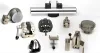
Essentials of grip & fixture selection in force & torque testing
For a test to work, the test system needs to properly interface with its specimen.
1253
Case study
Hygienic disposal bin closure testing
Customised engineering example
A manufacturer of hygienic disposal bins came to us with a nappy (diaper) disposal unit fitted with a rotary intake mechanism.
1254

Event
Texture Testing for Bakery Applications
The primary goal for using instrumentation to measure texture is to capture an objective value to something that is typically evaluated very subjectively. Texture cannot be controlled unless it measured in a consistent and repeatable manner.
1255
[Page extract]
ASTM F2132-01
This specification provides the performance requirements and associated test procedures for the puncture resistance of materials used in the construction of containers for discarded medical needles and other sharps.
1256
[Page extract]
Introduction to chord modulus
Chord modulus is a key parameter in material testing, providing engineers and quality control teams with a precise measure of a material’s stiffness under defined loading conditions.
1257
[Page extract]
ASTM D2063/D2063M
This test method measures torque retention properties of container/continuous thread closure systems with the use of a non-automated, spring torque-meter (with either a dial indicator or a digital readout) or a torque wrench. evaluation.
1258
[Page extract]
ISO 8033
ISO 8033 specifies methods for the determination of the adhesion between lining and reinforcement, between cover and reinforcement, between reinforcement layers, between cover and outer lamination (thin layer of material outside the cover for protection
1259
[Page extract]
Common test methods and standards
Internationally recognised standards ensure that compressibility and recovery testing is consistent and repeatable across laboratories and production sites.
1260
[Page extract]
Applications across industries
Compressive hardness testing is applied in many sectors to confirm that materials meet performance and safety criteria.
1261
[Page extract]
Introduction to yield point testing
Yield point testing is essential for understanding the mechanical behaviour of materials.
1262
[Page extract]
Torque testing methods
Programmable torque testers
Motorised torque testers allow engineers to define torque profiles, control rotational speed, and capture the complete torque-tension curve.
1263
[Page extract]
Destructive and non-destructive methods
Testing may be performed destructively or non-destructively depending on the objectives.
1264
Case study
Industrial fixtures and fasteners
Requirement
SFS intec is a global supplier of precision components, special fasteners and mechanical fastening elements, with long-standing customer relationships, in the aerospace, automotive and construction industries.
1265
[Page extract]
ISO 9187-1
ISO 9187-1:2010 specifies materials, dimensions, capacities, performance and packaging requirements for three forms of glass ampoule (forms B, C and D) for injectable pharmaceutical products.
1267
[Page extract]
Introduction to single lap shear testing
Single lap shear testing is a widely used method for determining the shear strength of an adhesive bond between two overlapping materials.
1268
[Page extract]
IEC 61210
IEC 61210:2010 applies to non-insulated flat quick-connect terminations consisting of a male tab of size 2,8 mm, 4,8 mm, 6,3 mm or 9,5 mm with hole or dimple detents and a mating female connector for use as either an incorporated or an integrated part o
1269
[Page extract]
Best practices in conducting cone penetration tests
Step-by-step procedure
Sample preparation - Condition the sample according to the standard, controlling temperature and humidity where required.
Equipment calibration - Confirm the
1270
[Page extract]
EN 22872
EN 22872 specifies two methods for testing complete, filled transport packages for compression resistance.
1271
[Page extract]
Introduction to penetration and puncture resistance testing
Penetration and puncture resistance testing are essential for evaluating how well a material can withstand force from sharp, pointed, or blunt objects.
1272
[Page extract]
Explore the new SqueezerPro
Designed for versatility and ease-of-use, the SqueezerPro will appeal to new and experienced users. A convenient bench-top design makes the SqueezerPro ideal for use in all industries, from QC in manufacturing production to R&D laboratories.
1273
[Page extract]
Introduction to breaking torque tests
Breaking torque testing, also known as torque-to-failure is a critical mechanical test used to determine the point at which a component or assembly fails under rotational force.
1274
[Page extract]
Understanding torque testing
Types of torque testing in packaging
Several torque measurements are relevant to closure performance:
1275
[Page extract]
Comparison with other bending methods
While the five-point bend test is designed to evaluate planar shear, other bending methods address different mechanical behaviours: