Search results
2276
[Page extract]
ASTM C1341
This test method covers the determination of flexural properties of continuous fiber-reinforced ceramic composites in the form of rectangular bars formed directly or cut from sheets, plates, or molded shapes.
2277
[Page extract]
ASTM D4964-96
5.1 This test method for testing loop tension and elongation of elastic fabrics is considered satisfactory for acceptance testing of commercial shipments of elastic fabrics because the test method is used in the trade for acceptance testing.
2278
[Page extract]
EN 14488-2
Part 1: Sampling fresh and hardened concrete
Part 2: Compressive strength of young sprayed concrete
Part 3: Flexural strengths (first peak, ultimate and residual) of fibre reinforced beam specimens
2279

Event
Cap Closure and Removal Torque Testing
The primary objective for measuring and analyzing the torque characteristics of a container cap is to accurately determine not only the quality of the part or process, but also the root cause of a wide variety of defects.
2280
[Page extract]
DIN EN 1464
This European Standard specifies a floating roller method for the determination of the peel resistance of high-strength adhesive bonds between one rigid adherend and one flexible adherend when tested under specified conditions of preparation and testing
2281

Event
Fundamentals of Food Texture Analysis
The primary goal for using instrumentation to measure texture is to capture an objective value to something that is typically evaluated very subjectively. Texture cannot be controlled unless it measured in a consistent and repeatable manner.
2282
[Page extract]
ASTM F2606-08
This guide can be used to obtain force versus deflection or midspan bending moment versus midspan curvature curves for stents and stent systems subjected to three-point bending conditions.
2283
[Page extract]
ISO 9727-2
This part of ISO 9727 specifies a test method for:
⎯ measuring the mass of cylindrical cork stoppers ready for use or semi-worked, totally or partially made of agglomerated cork, and
2284
[Page extract]
SAE AMSSTD
This standard covers the general requirements and methods for testing sandwich core materials and for testing sandwich construction of the types used primarily in aircraft structures.
2285
[Page extract]
ASTM C165
1.1 This test method covers two procedures for determining the compressive resistance of thermal insulations.
2286
[Page extract]
BS 5G 178-1
Provides updated tests and test requirements for crimped joints with copper, copper alloy, aluminium and aluminium alloy conductors.
2287
[Page extract]
ASTM D 2979
1.1 This test method covers measurement of the pressure sensitive tack of adhesives.
2288
[Page extract]
BS 6319-3
BS 6319-3 is a test method for determining the modulus of elasticity in flexure and flexural strength of resin and polymer/cement compositions for use in construction.
2289
[Page extract]
ASTM D380
ASTM D380 is a set of test methods for determining testing and inspection procedures for rubber hoses e.g. hydraulic hoses and automotive hoses.
2290
[Page extract]
BS 7882
This British Standard specifies the requirements for the calibration and classification of torque measuring devices including those used for the calibration of hand torque tools to BS EN 26789: 1994/
2291
[Page extract]
BS EN 2747
BS EN 2747 is a tensile test method for testing carbon fibre reinforced plastics.
Before conducting BS EN 2747, it is important to read the entire specification. Standards can be obtained from appropriate standard authorities.
2292
[Page extract]
ASTM D412-16
ASTM D412 is a test standard for testing the tensile stress-strain properties of thermoset rubbers and thermoplastic elastomers. The standard is divided into two test methods.
2293
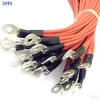
Event
Wire Crimp & Weld Testing Webinar
The only way of really knowing the strength of a crimped terminal is to pull it.
2294
[Page extract]
ISO 9073-3
Application of a force longitudinally to a test piece of a specified length and width at a constant rate of extension. Determination of values for breaking strength and elongation from the recorded force-elongation curve.
2295
[Page extract]
BS EN ISO 8295
ISO 8295 specifies a method for determining the coefficients of starting and sliding friction of plastics film and sheeting when sliding over the same or other substances. It is intended to be used for non-sticky plastic film and sheeting of up to appr
2296
[Page extract]
ASTM D3164
Test method ASTM D3164 is used to produce shear strength data for joints to compare adhesives or evaluation surface treatments. Shear joints impose uniform stresses across the bond area which results in the highest possible joint strength.
2297
[Page extract]
ASTM D5379/D5379M-05
This test method covers the shear properties of composite materials reinforced by high-modulus fibers. The composite materials are limited to continuous-fiber or discontinuous-fiber-reinforced composites in specific forms.
2298
[Page extract]
ASTM D6415 / D6415M-06a
ASTM D6415 is designed to measure the curved beam strength properties of fiber reinforced composites using a 90˚ curved beam specimen. The curved beam strength represents the moment per unit width which causes a delamination to form.
2299
[Page extract]
ASTM D6746-15
ASTM D6746 is a test standard that covers methods to evaluate a characteristic of raw rubber or unvulcanized rubber compounds that is designated as green strength.
2300
[Page extract]
TAPPI T 400
This method describes procedures for obtaining a representative sample for testing.