Search results
1551
Event
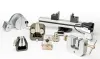
Webinar: Essentials of Grip & Fixture Selection in Force & Torque Testing
For a test to work, the test system needs to properly interface with its specimen.
1552

Event
Rice Texture Analysis
Rice is a staple food for billions of people worldwide, and its quality is intrinsically linked to its texture.
1553
[Page extract]
Understanding and interpreting test results
Box crush testing provides clear, measurable data to inform design and compliance decisions:
1554
[Page extract]
SAE J174M
This test procedure is intended to provide a quality control method for checking torque-tension characteristics of non-prevailing torque type threaded steel fasteners 6 through 24 mm nominal diameters.
1555
[Page extract]
ASTM D3846
ASTM D3486 is a test method used for evaluating the in-plane strength of reinforced thermosetting plastics in flat sheet form in thicknesses ranging from 2.54 to 6.60 mm.
1556
[Page extract]
BS EN ISO 527-2
ISO 527-2 specifies the test conditions for determining the tensile properties of moulding and extrusion plastics, based upon the general principles given in ISO 527-1.
1557
[Page extract]
The standard specifies the procedures for measuring the force required for needle penetration and the drag force as the needle travels through a simulated skin or tissue.
1558

Case study
Système d'essai de force de traction sur filet d'échafaudage
Exigence
Huck, un fournisseur de filets d'échafaudage, organise un retour chez le fabricant pour vérifier que les filets ne se sont pas dégradés pendant leur utilisation.
1559
[Page extract]
ISO 34-2 standards explained
ISO 34-2 specifies the Delft tear test procedure for vulcanised or thermoplastic rubber, ensuring testing is carried out under consisten
1560
[Page extract]
Tension testing process
Tension testing is the most common method for evaluating tensile deformation and produces quantitative data on how materials behave under controlled pulling forces.
1561
[Page extract]
What is bulk analysis testing?
Definition and purpose
Bulk analysis testing assesses the mechanical properties of particulate materials as a collective whole, rather than analysing individual particles. This includes powders, granules, pellets and similar materials.
1562
[Page extract]
Real-time data analysis and reporting
Mecmesin’s software platform offers live monitoring and evaluation of test performance:
1563
[Page extract]
ASTM D882-18
ASTM D882 is a test method that covers the determination of tensile properties of plastics in the form of thin sheeting and films (less than 1.0 mm (0.04 in.) in thickness). It is used to measure tensile properties including ultimate tensile
1564
[Page extract]
Introduction to tensile testing
Tensile testing is one of the most widely used methods in material science for determining the mechanical properties of materials under uniaxial tension.
1565

Event
Essentials of Adhesion (Peel) Testing
There is a reason people reach for Duct Tape as a fix for almost everything – Adhesion Strength. From busted pipes to ripped furniture, the preference for a solution that “does not easily peel off” is the guiding principle for manufactures.
1566
[Page extract]
ASTM D4255 / D4255M-15a
ASTM D4255 is a test method for testing the in-plane shear properties of high-modulus fiber-reinforced composite materials. The method is divided into two procedures. Procedure A tests laminates clamped between two pairs of loading rails.
1567
[Page extract]
Understanding corrugated cardboard resistance
The compressive resistance of corrugated cardboard depends on factors such as flute profile, board structure, and paper quality.
1568
Case study
Child resistant closures (CRC) mandrel
Customised engineering example
Child Resistant Closures (CRC) require sufficient vertical force to activate the CR locking mechanism prior to torque being applied.
1569
Case study
Display thin film coating 90 degree peel test
Requirement
The Thin Film Centre at University of Paisley conducts ground-breaking research into flexible displays and required the means to analyse the adhesion between films and their substrates.
1570
[Page extract]
Understanding test types
Material testing uses a variety of methods to assess different mechanical properties. Selecting the right test depends on the intended application and relevant standards.
Examples include:
1571

Page
Catalogue d'accessoires
Choisir vos accessoires
Pour obtenir des résultats de test précis, il est important que votre échantillon soit fixé et maintenu correctement.
1572
[Page extract]
Testing standards and guidelines
Tension and compression tests are governed by international standards that ensure comparability and regulatory compliance:
1573
[Page extract]
SAE J174
This test procedure is intended to provide a quality control method for checking torque-tension characteristics of non-prevailing torque type threaded steel fasteners 1/4 through 1 in nomial diameters.
1574

Event
Fundamentals of Adhesion (Peel) Testing
There is a reason people reach for Duct Tape as a fix for almost everything – Adhesion Strength. From busted pipes to ripped furniture, the preference for a solution that “does not easily peel off” is the guiding principle for manufactures.
1575
Case study
Pelage par accessoire à vide d'opercule sur emballage thermoscellable flexible
Exemple d'ingénierie sur mesure
Les emballages semi-rigides thermoformés, scellés par un film ou une feuille, sont couramment testés selon la méthode du «pelage à 45 °».