Search results
1526
[Page extract]
Medical devices and aids
Medical device manufacturers operate in one of the world’s most competitive and highly-regulated industries, where patient safety is critical.
1527
[Page extract]
What is peel testing
A peel test measures the force needed to separate two bonded materials, usually by applying force at a set angle until the adhesive bond fails.
1528
Event
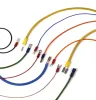
Tensile Testing for Wiring Harness Connections
The only way of really knowing the strength of a crimped terminal is to pull it. This can reveal production problems, where strand nicks, incorrect crimp height, or effects from changes in terminal supply, may not be clearly apparent.
1529
[Page extract]
Introduction to penetration and puncture resistance testing
Penetration and puncture resistance testing are essential for evaluating how well a material can withstand force from sharp, pointed, or blunt objects.
1530

Case study
Child resistant closures (CRC) mandrel
Customised engineering example
Child Resistant Closures (CRC) require sufficient vertical force to activate the CR locking mechanism prior to torque being applied.
1531
[Page extract]
Introduction to chord modulus
Chord modulus is a key parameter in material testing, providing engineers and quality control teams with a precise measure of a material’s stiffness under defined loading conditions.
1532
[Page extract]
What is the box crush test?
The box crush test (BCT) is a widely used method for measuring the compressive strength of fibreboard packaging, particu
1533
[Page extract]
Common test methods and standards
Internationally recognised standards ensure that compressibility and recovery testing is consistent and repeatable across laboratories and production sites.
1534
Case study
Automotive window winder turning effort
Requirement
The customer requested a portable system which would quickly and easily allow him to test the torque required to open and close windows in a car.
1535
[Page extract]
Introduction to penetration and puncture resistance testing
Penetration and puncture resistance testing are essential for evaluating how well a material can withstand force from sharp, pointed, or blunt objects.
1536
Event
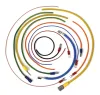
Tensile Testing for Wiring Harness Connections
The only way of really knowing the strength of a crimped terminal is to pull it. This can reveal production problems, where strand nicks, incorrect crimp height, or effects from changes in terminal supply, may not be clearly apparent.
1537
[Page extract]
Applications across industries
Compressive hardness testing is applied in many sectors to confirm that materials meet performance and safety criteria.
1538
[Page extract]
Introduction to yield point testing
Yield point testing is essential for understanding the mechanical behaviour of materials.
1539
Event
Tensile Testing for Wiring Harness Connections
The only way of really knowing the strength of a crimped terminal is to pull it. This can reveal production problems, where strand nicks, incorrect crimp height, or effects from changes in terminal supply, may not be clearly apparent.
1540
[Page extract]
Destructive and non-destructive methods
Testing may be performed destructively or non-destructively depending on the objectives.
1541
[Page extract]
ASTM D4833-07
This test method is an index test for determining the puncture resistance of geomembranes and related products. The use of this test method is to establish an index value by providing standard criteria and a basis for uniform reporting.
1542
[Page extract]
Students meet the Mecmesin MultiTest
Having spent time with the Mecmesin team and seen their material testers in action, WPI opted to invest in three Mecmesin MultiTest 2.5-dV testers.
1543
[Page extract]
Introduction to single lap shear testing
Single lap shear testing is a widely used method for determining the shear strength of an adhesive bond between two overlapping materials.
1545
[Page extract]
Understanding the stress-strain curve
The stress-strain curve is a primary tool for tensile strength analysis. It shows how a material responds to an increasing tensile load, providing detailed insights into its mechanical properties.
1546
Case study
Intégrité des grenades fumigènes
Exemple d'ingénierie personnalisée
Un fabricant de grenades fumigènes avait besoin d'un moyen de tester la force d'arrachement du bouchon.
1547
[Page extract]
Best practices in conducting cone penetration tests
Step-by-step procedure
Sample preparation - Condition the sample according to the standard, controlling temperature and humidity where required.
Equipment calibration - Confirm the
1548
[Page extract]
Measurement and testing methods
Techniques for measuring tangent modulus
Tangent modulus is measured during tensile or compression testing, w
1549
Case study
Essai de friction sur colonne de direction
Exemple d'ingénierie sur mesure
Certaines dimensions d'un composant peuvent rendre les tests de force difficiles à effectuer.
1550
[Page extract]
Understanding peel resistance
Peel resistance is the force required to separate two bonded surfaces through a peeling motion. This force is measured using a tensile test system equipped with a peel fixture.