Search results
526

Event
Materials Testing: Theory and Practice Pt. 2
Materials testing is often the last step in the manufacturing process. Yet, quality is the result of both the process and the material. If the material that goes into the product is inadequate or defective, then the product may be deficient or faulty.
527

Event
Medical Devices: Torque testing of Child Resistant Closures (CRC) with 21 CFR Part 11 compliance
Torque testing of Child Resistant Closures (CRC) with 21 CFR Part 11 compliance
528

Event
Medical Device Testing: Torque testing of Child Resistant Closures (CRC) with 21 CFR Part 11 compliance
Torque testing of Child Resistant Closures (CRC) with 21 CFR Part 11 compliance
529
[Page extract]
Cord, rope and netting
Cord, rope and netting all rely on their inherent strength to perform the essential tasks of tying, lifting and dragging.
530
[Page extract]
Springs
Springs are elastic objects used to store mechanical energy and they change shape in response to external forces, returning to their original shapes when the forces are removed.
531
[Page extract]
Tensile deformation and its significance
Tensile deformation occurs when a material is stretched by an axial load, causing it to elongate.
532
[Page extract]
Testing Procedure
Performing the needle penetration and drag test involves several steps:
533
[Page extract]
How is 180 degree peel testing performed
The test is carried out on a universal testing machine fitted with a suitable peel fixture.
534
[Page extract]
Electrical switches and connectors
Switches and connectors may be low-cost simple electro-mechanical devices but they are ubiquitous in millions of products and devices we use every single day.
535
Product
Digital Elmendorf Tear Tester
ElmaTear
903-305
Digital Elmendorf Tear Tester with TestWise™ software and touch-screen. Supplied with easy to fit pendulum weights suitable for testing woven and non-woven textiles as well as paper, plastic and other sheet materials.
536
[Page extract]
Secant modulus compared to other moduli
Different moduli are used to describe the stiffness of materials, each calculated at different points on the stress-strain curve:
537
[Page extract]
Understanding the stress-strain curve
The stress-strain curve is a primary tool for tensile strength analysis. It shows how a material responds to an increasing tensile load, providing detailed insights into its mechanical properties.
538

Event
Texture Testing: Meat & Plant-based Proteins
The quality of meat is determined by a number of factors including, tenderness, juiciness, and flavor.
539
[Page extract]
Motorised torque test stands
Repeatable torque testing
Looking for a motorised torque testing system to improve the accuracy and repeatability of your measurements compared to manual torque testers?
540
[Page extract]
ISO 9664
The principle of the method specified is cyclically stressing the specimen in a way that may be regarded as the superposition of an alternating stress on a static stress which is the mean stress.
541

Event
Live Demonstration: Face mask strength testing & Syringe plunger breakaway force testing
Medical device testing ensures patient safety, regulatory compliance, performance, quality, usability, claims examination, and post-market safety.
542
Event
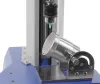
Needle Sharpness & Puncture Resistance Testing
Hypodermic needles are tested to determine how their design influences the ease of insertion into the skin in order to prevent patient pain and skin trauma.
543

Case study
Metal bottle cap on glass pull-off test
Customised engineering example
Gripping the base of a glass bottle for a tensile test can be challenging due to the slippy surface and contoured shape.
544
Case study
Insulation film stiffness testing
Customised engineering example
Familiar with three-point bending to test flexural strength properties?
545
[Page extract]
NF S86-604
This document defines the test methods for characterizing metallic watch straps and the corresponding requirements.
546
Case study
90 degree peel test filter paper
Customised engineering example
Floating roller peel jigs are regularly used for testing laminates where the backing sheet is rigid and the facing sheet is flexible (e.g. security cards)
547
Event
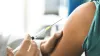
Medical Device Testing: Needle sharpness and syringe actuation testing (with 21 CFR Part 11 compliance)
Hypodermic needles are tested to determine their efficacy in piercing elastomer closures on vials and how their design influences the ease of insertion into the patient's skin, influencing pain and skin trauma.
The smooth and consistent operat
548
Case study
Medical sharps bin puncture resistance
Customised engineering example
International standards (ASTM F2132, BS 7320, BS 23907) specify the puncture resistance of medical sharps containers.
550
Event
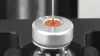
Needle Sharpness & Puncture Resistance Testing
Hypodermic needles are tested to determine how their design influences the ease of insertion into the skin in order to prevent patient pain and skin trauma.