Search results
1676
[Page extract]
BS EN ISO 12230
This European Standard specifies a method for the determination of the tensile properties of materials used as surfaces for sports areas.
1677
[Page extract]
BS EN 60794-1-21:2015+A1
This part of IEC 60794 applies to optical fibre cables for use with telecommunication equipment and devices employing similar techniques, and to cables having a combination of both optical fibres and electrical conductors.
1678
Test Frame
MultiTest test frame (twin column)
MultiTest test frame
A motorised test frame driven by twin ballscrews featuring dual-columns and designed to apply tension and compression from 2 N right up to a capacity of 50 kN (1100 lbf).Its versatile construction makes it perfectly suited for testing…
1679
[Page extract]
CETIE Guide 3 (FR)
Ce guide est destiné aux producteurs de vins mousseux de qualité qui réalisent la « prise de mousse » par fermentation en bouteilles.
1680
[Page extract]
ASTM D5766 / D5766-M
ASTM D5766 is a test method to determine the open-hole tensile strength of multidirectional polymer matrix composite laminates reinforced by high-modulus fibres.
1681
[Page extract]
ASTM F1304-18
ASTM F1304 is a test method used to determine the deflection of relatively rigid resilient floor tile such as vinyl composition tile and resilient flooring with a rigid polymeric core.
1682
[Page extract]
CETIE Guide 7
This guideline applies to the screw capping of still wines with a metallic closure having a threaded plastic insert and a tamper-evident band which needs to be snapped before it can be opened. The closure is screwed and crimped during capping.
1683
[Page extract]
ISO 36
ISO 36 determines the strength required to separate two plies of fabric bonded together with rubber, or a rubber and a fabric ply bonded together. This test is referred to as a “T-peel” test, because as the two adherends are pulled apart, they form the
1684
[Page extract]
ASTM F2256-05
This test method is intended to provide a means for comparison of the adhesive strengths of tissue adhesives intended for use as surgical adhesives or sealants, or both, on soft tissue.
1685
[Page extract]
BS ISO 6133
BS ISO 6133 specifies five methods of calculating, after testing, the tear strength and the adhesion strength of vulcanized rubber or fabrics coated with or adhered to rubber or plastics.
1686
[Page extract]
BS EN ISO 4624
Describes methods for determining the adhesion by carrying out a pull-off test on a single coating or a multi-coat system of paint, varnish or related product.
1687
Event
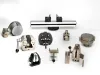
Webinar: Master Grips & Fixtures for Consistent Testing
When physically testing a material or component, the ability to apply load to a test specimen is important—but having the ability to apply that load correctly is just as crucial.
1688
[Page extract]
ISO 6237
Specifies a method for determining the shear strength of wood-to-wood adhesive bonds, with a standard specimen loaded in tension and under specified conditions of preparation, conditioning and testing.
1689
[Page extract]
ISO 5628
Specifies three test methods for determining the bending stiffness of paper and paperboard. The test methods differ in the type of loading mode, thus giving rise to the two-point, three-point and four-point bending test methods.
1690
[Page extract]
TAPPI T 839
This method describes procedures for determining the edgewise compressive strenght, with flutes vertical, loading perpendicular to the axis of the flutes, of a short column of single, double, or triple-wall corrugated fiberboard.
1691

Event
Fundamentals of Food Texture Analysis
The primary goal for using instrumentation to measure texture is to capture an objective value to something that is typically evaluated very subjectively. Texture cannot be controlled unless it measured in a consistent and repeatable manner.
1692
[Page extract]
ASTM C1424
This test method covers the determination of compressive strength including stress-strain behavior, under monotonic uniaxial loading of advanced ceramics at ambient temperature. This test method is restricted to specific test specimen geometries.
1693
[Page extract]
SAE AIR 1471A
The purpose of this SAE Aerospace Information Report (AIR) is to provide the aerospace propulsion industry with recommended assembly torque limits for commonly used aircraft propulsion system threaded fasteners when a common torque value per fastener si
1694
Event
Fundamentals of Texture Testing Analysis
The primary goal for using instrumentation to measure texture is to capture an objective value to something that is typically evaluated very subjectively. Texture cannot be controlled unless it measured in a consistent and repeatable manner.
1695
[Page extract]
ASTM C1674
This test method covers the determination of the flexural strength (modulus of rupture in bending) at ambient conditions of advanced ceramic structures with 2-dimensional honeycomb channel architectures.
1697

Event
Essentials of Adhesion (Peel) Testing
There is a reason people reach for Duct Tape as a fix for almost everything – Adhesion Strength. From busted pipes to ripped furniture, the preference for a solution that “does not easily peel off” is the guiding principle for manufactures.
1698
Event
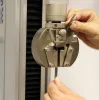
Essentials of GRIP & FIXTURE Selection in Force & Torque Testing Webinar
When physically testing a material or component, the ability to apply load to a test specimen is important—but having the ability to apply that load correctly is just as crucial.
1699
[Page extract]
ISO 8627
Specification of a test method and grading scheme for the stiffness of the tufted area of conventional manual tooth-brushes, together with the relevant information concerning definitions and those concerning testing machines.
1700
[Page extract]
ASTM D3577
1. Scope ... 1.1 This specification describes certain requirements for packaged sterile rubber surgical gloves used in conducting surgical procedures.