Search results
1976
[Page extract]
ASTM D3810
This test method covers the determination of or the recommendation for minimum application torque that results in a fully degraded removal torque that is at a level greater than the maximum expected reverse-ratchet torque for a Type IA child-resistant c
1977
[Page extract]
ISO 8510-1
Particularly suitable for use with less flexible adherends for which a 180 ° peel test is not suitable because the adherends crack, break or delaminate. A bonded assembly of two adherends is prepared using the adhesive under test.
1978
[Page extract]
ASTM D6068-10
This test method covers the determination of the J-integral versus crack growth resistance (J-R) curves for polymeric materials.
1979

Event
Fundamentals of Texture Testing Analysis
The primary goal for using instrumentation to measure texture is to capture an objective value to something that is typically evaluated very subjectively. Texture cannot be controlled unless it measured in a consistent and repeatable manner.
1980
[Page extract]
ISO 11502
Describes a qualitative and a quantitative method for assessing the tendency of flexible plastics films and sheets to adhere to one another when left in contact for some time, at a specified temperature and under light pressure.
1981
[Page extract]
ISO 1798
ISO 1798 specifies a method for determining the strength and deformation properties of flexible cellular materials when a test piece is extended at a constant rate until it breaks.
This test standard is equivalent to BS EN ISO 1798:2008
1982
[Page extract]
ISO 36
ISO 36 determines the strength required to separate two plies of fabric bonded together with rubber, or a rubber and a fabric ply bonded together. This test is referred to as a “T-peel” test, because as the two adherends are pulled apart, they form the
1983

Event
Essentials of Adhesion (Peel) Testing
Across many households and industries, consumers have developed a strong preference for and confidence in ‘Duct Tape’ for all types of uses and applications. This is mainly due to the adhesion strength.
1984
[Page extract]
ASTM D1708
ASTM D1708 is used to determine the tensile and elongation properties of small plastic microtensile specimens. These plastic specimens can be of any thickness up to 3.2 mm (1/8 in), including thin films. This test method does not require the use of an
1985
[Page extract]
BS EN 12311-2
BS EN 12311-2 is a test method for determining the tensile properties of flexible sheets used for waterproofing roofs.
1986
[Page extract]
ASTM D5034-09
This test method covers the grab and modified grab test procedures for determining the breaking strength and elongation of most textile fabrics. Provisions are made for wet testing.
1987
[Page extract]
ASTM D2659
ASTM D2659 determines the mechanical properties of blown thermoplastic containers under columnar crush conditions at a steady rate of compression. Any container, whether blown commercially or in the laboratory, may be used as the test specimen.
1988
[Page extract]
BS EN ISO 14129
BS EN ISO 14129 is a test method used to determine the in-plane shear stress/shear strain response of fibre-reinforced plastic components.

1991
[Page extract]
Scissor grips
Scissor grips - self-tightening and self-aligning with the specimen initially being held by spring tension.
1992
[Page extract]
ASTM C203
ASTM C203 is a test method that covers the determination of the breaking load and calculated flexural strength of a rectangular cross section of a preformed block-type thermal insulation tested as a simple beam.
1993
[Page extract]
ASTM D5467 / D5467M-97
ASTM D5467 is a test method that determines the in-plane compressive properties of polymer matrix composite materials reinforced by high-modulus fibers in a sandwich beam configuration.
1994
[Page extract]
ASTM D1321
This test method covers the empirical estimation of the consistency of waxes derived from petroleum by measurement of the extent of penetration of a standard needle.
1995
[Page extract]
ISO 178
ISO 178 is a test method for the determination of flexural properties of rigid and semi-rigid plastics. These properties include flexural modulus and flexural strength.
1996
Event
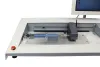
Understanding Adhesion Strength: 180 Degree Peel Test
Across many households and industries, consumers have developed a strong preference for and confidence in ‘Duct Tape’ for all types of uses and applications. This is mainly due to the adhesion strength.
1997
[Page extract]
ISO 7622-1
ISO 7622-1 specifies a method for the determination of the elongation of steel cords constituting the carcass of conveyor belts, when subjected to a force corresponding to 10 % and 60 % of the specified tensile strength.
1998
[Page extract]
ASTM D7137 / D7137M-17
ASTM D7137 is a test method that measures the compression residual strength properties of multidirectional polymer matrix composite laminated plates, which have been subjected to quasi-static indentation
1999
[Page extract]
BS 6319-7
BS 6319-7 is a test method for determining the tensile strength of resin and polymer/cement compositions for use in construction.
2000
[Page extract]
BS EN ISO 16409
Describes performance criteria for manual interdental brushes with a round cross-section of the brush head and consisting of a wired stem with inserted filaents.
Of particular interest is the Stem Retention Force (sections 5.4 and 7.6)