Search results
1176
[Page extract]
Why is texture testing important?
Texture testing ensures consistent product performance, supports process control, and validates compliance with industry standards. Even small changes in raw materials, processing conditions, or environmental factors can alter texture.
1177

Event
Texture Testing for Bakery Applications
The primary goal for using instrumentation to measure texture is to capture an objective value to something that is typically evaluated very subjectively. Texture cannot be controlled unless it measured in a consistent and repeatable manner.
1178
[Page extract]
What is the box crush test?
The box crush test (BCT) is a widely used method for measuring the compressive strength of fibreboard packaging, particu
1179
[Page extract]
Introduction to compressive strength testing
Compressive strength testing is essential for evaluating the ability of materials to withstand axial loads, which are forces that push or pull them.
1180
[Page extract]
ASTM D2063/D2063M
This test method measures torque retention properties of container/continuous thread closure systems with the use of a non-automated, spring torque-meter (with either a dial indicator or a digital readout) or a torque wrench. evaluation.
1181
[Page extract]
ISO 8033
ISO 8033 specifies methods for the determination of the adhesion between lining and reinforcement, between cover and reinforcement, between reinforcement layers, between cover and outer lamination (thin layer of material outside the cover for protection
1182
[Page extract]
What is the 135° peel test?
The 135° peel test is a method for measuring the seal strength of semi-rigid packaging, typically where a flexible lid is sealed onto a rigid or vacuum-formed container.
1183
[Page extract]
Step-by-step guide to conducting the ring crush test
Prepare the sample
Cut samples to the required size specified by the relevant standard, typically corresponding to a circumference of 152 mm. Condition the samples at the specified temperature and humidity.
1184
[Page extract]
BS EN 12090
Thermal insulating materials, Thermal insulation, Construction materials, Shear testing, Shear strength, Shear stress, Specimen preparation, Formulae (mathematics), Test specimens, Test equipment, Testing conditions, Adhesives, Mechanical testing, Repor
1185

Case study
Hygienic disposal bin closure testing
Customised engineering example
A manufacturer of hygienic disposal bins came to us with a nappy (diaper) disposal unit fitted with a rotary intake mechanism.
1186
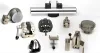
Event
Essentials of grip & fixture selection in force & torque testing
For a test to work, the test system needs to properly interface with its specimen.
1187
[Page extract]
ISO 9187-1
ISO 9187-1:2010 specifies materials, dimensions, capacities, performance and packaging requirements for three forms of glass ampoule (forms B, C and D) for injectable pharmaceutical products.
1188
[Page extract]
EN 22872
EN 22872 specifies two methods for testing complete, filled transport packages for compression resistance.
1189
Case study
Diamante pull-off test
Requirement
The customer was a supplier to major UK clothing retailer Marks & Spencer, who stipulate that all fasteners and attachments must be tested to failure.
1190
Case study
Industrial fixtures and fasteners
Requirement
SFS intec is a global supplier of precision components, special fasteners and mechanical fastening elements, with long-standing customer relationships, in the aerospace, automotive and construction industries.
1191
[Page extract]
ISO 11070
Specifies requirements for introducer needles, introducer catheters, sheath introducers, guidewires and dilators supplied in sterile condition and intended for single use in conjunction with intravascular catheters specified in ISO 10555-1.
1192
[Page extract]
Best practices in conducting cone penetration tests
Step-by-step procedure
Sample preparation - Condition the sample according to the standard, controlling temperature and humidity where required.
Equipment calibration - Confirm the
1193
[Page extract]
Common test methods and standards
Internationally recognised standards ensure that compressibility and recovery testing is consistent and repeatable across laboratories and production sites.
1194
[Page extract]
Introduction to penetration and puncture resistance testing
Penetration and puncture resistance testing are essential for evaluating how well a material can withstand force from sharp, pointed, or blunt objects.
1195
[Page extract]
Applications across industries
Compressive hardness testing is applied in many sectors to confirm that materials meet performance and safety criteria.
1196
[Page extract]
Introduction to yield point testing
Yield point testing is essential for understanding the mechanical behaviour of materials.
1198
[Page extract]
BS EN ISO 12230
This European Standard specifies a method for the determination of the tensile properties of materials used as surfaces for sports areas.
1199
[Page extract]
BS EN ISO 376
BS EN ISO 376:2011 looks at the calibration of force-proving instruments used for the static verification of uniaxial testing equipment. These include tension and compression testing machines.
1200
Case study
最高负荷测试PET瓶
要求Esterform Packaging每天为瓶装水,果汁,软饮料,乳制品和家用产品的主要加工商生产超过一百万个PET瓶和瓶坯。在生产过程中,Esterform需要能够根据公司严格的质量标准评估PET瓶的轴向负载能力。这是确保瓶子在灌装和封盖过程中或堆放运输和存放时不会弯曲的关键因素。