Search results
2301

Event
Fundamentals of Food Texture Analysis
The primary goal for using instrumentation to measure texture is to capture an objective value to something that is typically evaluated very subjectively. Texture cannot be controlled unless it measured in a consistent and repeatable manner.
2302
[Page extract]
PSTC 101
These methods cover the measurement of the peel adhesion of pressure sensitive tapes.
2303
[Page extract]
ASTM C1341
This test method covers the determination of flexural properties of continuous fiber-reinforced ceramic composites in the form of rectangular bars formed directly or cut from sheets, plates, or molded shapes.
2304
[Page extract]
ASTM D7137 / D7137M-17
ASTM D7137 is a test method that measures the compression residual strength properties of multidirectional polymer matrix composite laminated plates, which have been subjected to quasi-static indentation
2305
[Page extract]
CETIE Guide 5
This document gives background information and recommended best practices for the application of plastic flat-top screw-on caps onto PET bottles for beverages. It covers all closure sizes and beverage product types.
2306
[Page extract]
ISO 9727-2
This part of ISO 9727 specifies a test method for:
⎯ measuring the mass of cylindrical cork stoppers ready for use or semi-worked, totally or partially made of agglomerated cork, and
2308

Event
Tensile Testing: Basics, Tips and Trends
Have you ever wondered if the seatbelt in your vehicle is strong enough to restrain you in a collision? How about the average person pulling the cork out of a wine bottle?
2309
Event
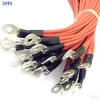
Wire Crimp & Weld Testing Webinar
The only way of really knowing the strength of a crimped terminal is to pull it.
2310
[Page extract]
EN 14488-2
Part 1: Sampling fresh and hardened concrete
Part 2: Compressive strength of young sprayed concrete
Part 3: Flexural strengths (first peak, ultimate and residual) of fibre reinforced beam specimens
2311
[Page extract]
BS 5G 178-1
Provides updated tests and test requirements for crimped joints with copper, copper alloy, aluminium and aluminium alloy conductors.
2312
[Page extract]
BS 6319-3
BS 6319-3 is a test method for determining the modulus of elasticity in flexure and flexural strength of resin and polymer/cement compositions for use in construction.
2313
[Page extract]
BS EN 2747
BS EN 2747 is a tensile test method for testing carbon fibre reinforced plastics.
Before conducting BS EN 2747, it is important to read the entire specification. Standards can be obtained from appropriate standard authorities.
2314
[Page extract]
SAE AMSSTD
This standard covers the general requirements and methods for testing sandwich core materials and for testing sandwich construction of the types used primarily in aircraft structures.
2315
[Page extract]
BS EN ISO 16409
Describes performance criteria for manual interdental brushes with a round cross-section of the brush head and consisting of a wired stem with inserted filaents.
Of particular interest is the Stem Retention Force (sections 5.4 and 7.6)
2316
[Page extract]
TAPPI T 400
This method describes procedures for obtaining a representative sample for testing.
2317
[Page extract]
BS 7882
This British Standard specifies the requirements for the calibration and classification of torque measuring devices including those used for the calibration of hand torque tools to BS EN 26789: 1994/
2318
[Page extract]
ASTM D3164
Test method ASTM D3164 is used to produce shear strength data for joints to compare adhesives or evaluation surface treatments. Shear joints impose uniform stresses across the bond area which results in the highest possible joint strength.
2319
[Page extract]
ASTM D4964-96
5.1 This test method for testing loop tension and elongation of elastic fabrics is considered satisfactory for acceptance testing of commercial shipments of elastic fabrics because the test method is used in the trade for acceptance testing.
2320
[Page extract]
ASTM D6415 / D6415M-06a
ASTM D6415 is designed to measure the curved beam strength properties of fiber reinforced composites using a 90˚ curved beam specimen. The curved beam strength represents the moment per unit width which causes a delamination to form.
2321
[Page extract]
BS EN ISO 8295
ISO 8295 specifies a method for determining the coefficients of starting and sliding friction of plastics film and sheeting when sliding over the same or other substances. It is intended to be used for non-sticky plastic film and sheeting of up to appr
2322
[Page extract]
ISO 13954
ISO 13954 describes a peel test method for determining the decohesive resistance of polyethylene electrofusion socket assemblies for use in the distribution of fluids.
2323
[Page extract]
ASTM C165
1.1 This test method covers two procedures for determining the compressive resistance of thermal insulations.
2324
[Page extract]
ASTM D 2979
1.1 This test method covers measurement of the pressure sensitive tack of adhesives.