Search results
1251
Event
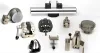
Essentials of grip & fixture selection in force & torque testing
For a test to work, the test system needs to properly interface with its specimen.
1252
[Page extract]
What is the box crush test?
The box crush test (BCT) is a widely used method for measuring the compressive strength of fibreboard packaging, particu
1253
[Page extract]
ASTM D2063/D2063M
This test method measures torque retention properties of container/continuous thread closure systems with the use of a non-automated, spring torque-meter (with either a dial indicator or a digital readout) or a torque wrench. evaluation.
1254
[Page extract]
What is the 135° peel test?
The 135° peel test is a method for measuring the seal strength of semi-rigid packaging, typically where a flexible lid is sealed onto a rigid or vacuum-formed container.
1255
[Page extract]
ISO 8033
ISO 8033 specifies methods for the determination of the adhesion between lining and reinforcement, between cover and reinforcement, between reinforcement layers, between cover and outer lamination (thin layer of material outside the cover for protection
1256

Event
Texture Testing for Bakery Applications
The primary goal for using instrumentation to measure texture is to capture an objective value to something that is typically evaluated very subjectively. Texture cannot be controlled unless it measured in a consistent and repeatable manner.
1257
[Page extract]
Common test methods and standards
Internationally recognised standards ensure that compressibility and recovery testing is consistent and repeatable across laboratories and production sites.
1258
[Page extract]
BS EN ISO 12230
This European Standard specifies a method for the determination of the tensile properties of materials used as surfaces for sports areas.
1259
[Page extract]
BS EN ISO 376
BS EN ISO 376:2011 looks at the calibration of force-proving instruments used for the static verification of uniaxial testing equipment. These include tension and compression testing machines.
1260
[Page extract]
Applications across industries
Compressive hardness testing is applied in many sectors to confirm that materials meet performance and safety criteria.
1261
[Page extract]
Introduction to yield point testing
Yield point testing is essential for understanding the mechanical behaviour of materials.
1262
[Page extract]
Torque testing methods
Programmable torque testers
Motorised torque testers allow engineers to define torque profiles, control rotational speed, and capture the complete torque-tension curve.
1263
[Page extract]
Destructive and non-destructive methods
Testing may be performed destructively or non-destructively depending on the objectives.
1264

Caso de estudio
Pruebas de par de cierre en botellas de plástico multidireccionales
Ejemplo de ingeniería personalizada Una empresa farmacéutica quería probar el par de cierre de una serie de botellas de PET de perfil cuadrado.
1265
Caso de estudio
Industrial fixtures and fasteners
Requirement
SFS intec is a global supplier of precision components, special fasteners and mechanical fastening elements, with long-standing customer relationships, in the aerospace, automotive and construction industries.
1266
[Page extract]
Introduction to single lap shear testing
Single lap shear testing is a widely used method for determining the shear strength of an adhesive bond between two overlapping materials.
1268
[Page extract]
ISO 11070
Specifies requirements for introducer needles, introducer catheters, sheath introducers, guidewires and dilators supplied in sterile condition and intended for single use in conjunction with intravascular catheters specified in ISO 10555-1.
1269
[Page extract]
Best practices in conducting cone penetration tests
Step-by-step procedure
Sample preparation - Condition the sample according to the standard, controlling temperature and humidity where required.
Equipment calibration - Confirm the
1270
[Page extract]
Introduction to penetration and puncture resistance testing
Penetration and puncture resistance testing are essential for evaluating how well a material can withstand force from sharp, pointed, or blunt objects.
1271
[Page extract]
Explore the new SqueezerPro
Designed for versatility and ease-of-use, the SqueezerPro will appeal to new and experienced users. A convenient bench-top design makes the SqueezerPro ideal for use in all industries, from QC in manufacturing production to R&D laboratories.
1272
[Page extract]
Introduction to breaking torque tests
Breaking torque testing, also known as torque-to-failure is a critical mechanical test used to determine the point at which a component or assembly fails under rotational force.
1273
[Page extract]
ASTM C133-97
ASTM C133-97 outlines standardized test methods for determining the cold crushing strength and modulus of rupture of refractory materials.
1274
[Page extract]
ASTM D7257-06
This test method of applying force may be used as a standard test to compare the characteristics of a given design of container/child-resistant closure system with a standard or to compare the characteristics of container/child resistant closure systems
1275
[Page extract]
Understanding torque testing
Types of torque testing in packaging
Several torque measurements are relevant to closure performance: