Search results
1776
[Page extract]
ASTM D3410 / D3410M
ASTM D3410 determines the compressive properties of polymer matrix composite materials reinforced by high-modulus fibers.
1777
[Page extract]
ASTM D790-17
ASTM D790 is used to determine the flexural properties of unreinforced and reinforced plastics, including high modulus composites and electrical insulating materials utilizing a three-point loading system to apply a load to a simply supported beam (spec
1778
[Page extract]
BS EN ISO 80369-1
BS EN ISO 80369 “Small-bore connectors for liquids and gases in healthcare applications. Connectors for intravascular or hypodermic applications”.
This standard replaces BS EN ISO 594-1: 1986, BS EN 20594-1:1994, and BS EN 1707:1997.
1779

Event
Makers Hackathon, June 16-18th 2022, Malmö, Sweden
Who should attend?
Quality Managers, design/product engineers and materials specialist.
What is the exhibition about?
1780
[Page extract]
ASTM D2919
This test method covers data for assessing the durability of adhesive lap-shear joints while stressed in contact with air, air in equilibrium with certain solutions, water, aqueous solutions, or other environments at various temperatures.
1781
[Page extract]
SAE J1701M
This SAE Information Report is provided as an advisory guide. Individual application discretion is recommended. The content has been presented as accurately as possible, but responsibility for its application lies with the user.
1782
[Page extract]
ASTM D6112-18
ASTM D6112 cover the determination of the creep and creep-rupture properties of plastic lumber and shapes, when loaded in compression or flexure under specified environmental conditions. Test specimens in the “as-manufactured” form are employed.
1783
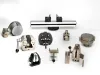
Event
Webinar: Master Grips & Fixtures for Consistent Testing
When physically testing a material or component, the ability to apply load to a test specimen is important—but having the ability to apply that load correctly is just as crucial.
1784
[Page extract]
ASTM D2344 / D2344M
ASTM D2344 is a test method, which determines the short-beam strength of high-modulus fiber-reinforced composite materials. It is applicable to all types of parallel fiber reinforced plastics and composites.
1785
[Page extract]
BS EN 12242
The BS EN 12242 test method is used to determine the peel strength of a touch and close (also known as “hook and loop”) fastener through a 180° peel test that is able to determine average peel and the peel strength characteristics of the product for a g
1786
[Page extract]
BS EN 12697-23
This standard specifies a test method for determining the (splitting) indirect tensile strength of cylindrical specimens of bituminous mixtures.
1787
[Page extract]
ASTM D6272-17
This test method covers the determination of flexural properties of unreinforced and reinforced plastics, including high-modulus composites and electrical insulating materials in the form of rectangular bars molded directly or cut from sheets, plates, o
1788
[Page extract]
BS EN ISO 8295
ISO 8295 specifies a method for determining the coefficients of starting and sliding friction of plastics film and sheeting when sliding over the same or other substances. It is intended to be used for non-sticky plastic film and sheeting of up to appr
1789
[Page extract]
ASTM D429-14
ASTM D429 is a test method used to determine the adhesion of rubber to metal substrates. It comprises 8 different tests: A through to H, covering tensile strength, peel and shear strength of the adhesion interface.
1790
[Page extract]
SAE J1701
This SAE Information Report is provided as an advisory guide. Individual application discretion is recommended. The content has been presented as accurately as possible, but responsibility for its application lies with the user.
1791
[Page extract]
ASTM D7137 / D7137M-17
ASTM D7137 is a test method that measures the compression residual strength properties of multidirectional polymer matrix composite laminated plates, which have been subjected to quasi-static indentation
1792
[Page extract]
ASTM F152-95
ASTM F152 is a test standard that covers tensile strength of nonmetallic gasketing materials at room temperature.
1793
[Page extract]
ISO 14126
ISO 14126 outlines procedures for determining the compressive properties of fibre-reinforced plastics composites in the in-plane direction. Two methods are detailed in the standard:
1794
[Page extract]
ISO 283
ISO 283 specifies a test method for the determination of the full thickness tensile strength in the longitudinal direction and the elongation at the reference force and breaking point of conveyor belts having a textile carcass.
1795
[Page extract]
BS ISO 5893
ISO 5893 specifies requirements for tensile-testing systems operating at constant rate of traverse and suitable for testing rubbers, plastics and adhesives, although any one system may only be applicable to a narrower range of materials.
1796

Event
Packaging: Establishing repeatability and consistency
Ensuring the quality and durability of packaging is crucial for maintaining product integrity from production to delivery.
1797
[Page extract]
ISO 9895
Specifies a method for determining the compressive strength in the machine and cross-directions of paper and board using a short-span compressive tester. It is intended for papers and boards used for the manufacture of containers and boxes.
1798
[Page extract]
ISBT PTC-00004
These ISBT (International Society of Beverage Technologists) Sport Closure test methods focus on child safety related parameters such as separation forces and choking hazards of closure components.
1799
[Page extract]
ASTM E1820-18ae1
The ASTM E1820 test method covers procedures and guidelines for the determination of fracture toughness of metallic materials using the following parameters: K, J, and CTOD (δ). Toughness can be measured in the R-curve format or as a point value.
1800
[Page extract]
TAPPI related
TAPPI Standards compared to Related Standards of ISO and ASTM (revised August 2011)