Search results
1601
[Page extract]
ASTM D3470
This test method covers the determination of the force required to cause a downward-force-while-turning lug-finish closure to be rotated across the container finish lugs (strippage) without downward force being applied to the closure (Type IIA closures)
1602

Event
Critical strength: Perfecting catalyst and pellet crush testing
Catalysts are widely used in industrial processes where yield and time issues are critical to forming a product as soon as possible.
1603
[Page extract]
ASTM D6241-04
This test method for determining the puncture strength of geotextiles is to be used by the industry as an index of puncture strength.
1604
[Page extract]
ASTM D3578
Scope... 1.1 This specification describes certain requirements for natural rubber gloves used in conducting medical examinations and diagnostic and therapeutic procedures. It also covers natural rubber gloves used in handling contaminated medical
1605
[Page extract]
BS EN 3841-509
This standard specifies a method of determining the forces required to insert and extract the contact pin into and out of the terminal socket of the signal contact. It shall be used together with EN 3841-100.
1606
[Page extract]
BS 373
Wood, Mechanical testing, Strength of materials, Test specimens, Specimen preparation, Moisture measurement, Density measurement, Physical property measurement, Static loading, Impact testing, Bend testing, Compression testing, Shear testing, Cleavage,
1607
[Page extract]
ISBT PTC-00002
This ISBT (International Society of Beverage Technologists) publication outlines dimensional and physical characterization and performance test methods for PET beverage bottles for use in CSD (Carbonated Soft Drink), Hotfill, and Cold Fill applications.
1608
[Page extract]
CETIE Guide 7 (FR)
Ce guide concerne le bouchage à vis des vins tranquilles, avec une fermeture métallique avec insert plastique fileté et témoin de violabilité ou bande de garantie qui doit être déchiré à l’ouverture.
1609

Event
Coefficient of Friction (COF) Testing
Coefficient of Friction (COF) testing measures the static and kinetic friction values to help determine the quality of the final product.
1610
Marco de prueba
Vortex-dv test frame
Vortex test frame
A sturdy twin-column test frame capable of applying torque up to 10 N.m (90 lbf.in). Tall and wide enough to accept a variety of test specimens yet compact to use as a bench-top tester.
View test frame
1611
[Page extract]
ASTM F1140/F1140M-13
These test methods provide a rapid means of evaluating tendencies for package failure when the package is exposed to a pressure differential. Pressure differentials may occur during processes such as sterilization and transportation.
1612
[Page extract]
BS EN ISO 10591
This International Standard specifies a method for the determination of the influence of water on the adhesion cohesion properties of sealants with predominantly plastic behaviour which are used in joints in building construction.
1613
[Page extract]
ASTM D5179-16
ASTM D5179 is a test method for determining organic coatings adhesion to a plastic substrate. It can be used to evaluate the adhesion (pull-off strength) of various coating/substrate combinations e.g. paint and varnish.
1614
[Page extract]
BS EN ISO 11857
Textile floor coverings, Floor coverings, Sheet flooring, Mechanical testing, Textile testing, Textiles, Tensile testing, Test equipment, Test specimens, Testing conditions.
1615
[Page extract]
ASTM D5934-02
ASTM D5934 specifies the use of controlled rate of loading mechanical instrumentation on rectangular plastic bars molded directly or cut from sheets, plates, or molded shapes via three-point loading bending techniques to obtain material properties such
1616
[Page extract]
ISO 11608-5
This part of ISO 11608 specifies requirements and test methods for the automated functions of needle-based injection systems with automated functions (NIS-AUTO), for the administration of medicinal products in humans.
1617
[Page extract]
ASTM D6068-10
This test method covers the determination of the J-integral versus crack growth resistance (J-R) curves for polymeric materials.
1618
[Page extract]
BS EN ISO 4624
Describes methods for determining the adhesion by carrying out a pull-off test on a single coating or a multi-coat system of paint, varnish or related product.
1619
[Page extract]
BS 5G 178-1
Provides updated tests and test requirements for crimped joints with copper, copper alloy, aluminium and aluminium alloy conductors.
1620
[Page extract]
ISO 6237
Specifies a method for determining the shear strength of wood-to-wood adhesive bonds, with a standard specimen loaded in tension and under specified conditions of preparation, conditioning and testing.
1621
[Page extract]
ISO 5628
Specifies three test methods for determining the bending stiffness of paper and paperboard. The test methods differ in the type of loading mode, thus giving rise to the two-point, three-point and four-point bending test methods.
1622
[Page extract]
ASTM C1424
This test method covers the determination of compressive strength including stress-strain behavior, under monotonic uniaxial loading of advanced ceramics at ambient temperature. This test method is restricted to specific test specimen geometries.
1623
[Page extract]
TAPPI T 839
This method describes procedures for determining the edgewise compressive strenght, with flutes vertical, loading perpendicular to the axis of the flutes, of a short column of single, double, or triple-wall corrugated fiberboard.
1624
[Page extract]
ASTM C1674
This test method covers the determination of the flexural strength (modulus of rupture in bending) at ambient conditions of advanced ceramic structures with 2-dimensional honeycomb channel architectures.
1625
Event
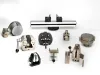
Webinar: Master Grips & Fixtures for Consistent Testing
When physically testing a material or component, the ability to apply load to a test specimen is important—but having the ability to apply that load correctly is just as crucial.