Search results
2301
[Page extract]
ASTM D349
These test methods cover the procedures for testing rigid round rods used in electrical insulation.
2302
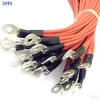
Event
Wire Crimp & Weld Testing Webinar
The only way of really knowing the strength of a crimped terminal is to pull it.
2303
[Page extract]
ISO 9727-2
This part of ISO 9727 specifies a test method for:
⎯ measuring the mass of cylindrical cork stoppers ready for use or semi-worked, totally or partially made of agglomerated cork, and
2304
[Page extract]
ASTM F2606-08
This guide can be used to obtain force versus deflection or midspan bending moment versus midspan curvature curves for stents and stent systems subjected to three-point bending conditions.
2305
[Page extract]
ISO 10354
Simulates in a qualitative manner the forces and effects on an adhesive-bonded joint at a metal-adhesive/primer interface. It can also be used as a method of checking the surface preparation of substrates.
2306

Event
Fundamentals of Food Texture Analysis
The primary goal for using instrumentation to measure texture is to capture an objective value to something that is typically evaluated very subjectively. Texture cannot be controlled unless it measured in a consistent and repeatable manner.
2307
[Page extract]
ISO 12625-5
ISO 12625-5:2005 specifies a test method for the determination of the wet tensile strength of tissue paper and tissue products after soaking with water, using a tensile-strength-testing apparatus operating with a constant rate of elongation.
2308
[Page extract]
ASTM D 2979
1.1 This test method covers measurement of the pressure sensitive tack of adhesives.
2309
[Page extract]
ASTM D6746-15
ASTM D6746 is a test standard that covers methods to evaluate a characteristic of raw rubber or unvulcanized rubber compounds that is designated as green strength.
2310
[Page extract]
BS 6319-3
BS 6319-3 is a test method for determining the modulus of elasticity in flexure and flexural strength of resin and polymer/cement compositions for use in construction.
2311
[Page extract]
ASTM D380
ASTM D380 is a set of test methods for determining testing and inspection procedures for rubber hoses e.g. hydraulic hoses and automotive hoses.
2312

Event
Understanding Adhesion Strength: 180 Degree Peel Test
Across many households and industries, consumers have developed a strong preference for and confidence in ‘Duct Tape’ for all types of uses and applications. This is mainly due to the adhesion strength.
2313
[Page extract]
ASTM F2256-05
This test method is intended to provide a means for comparison of the adhesive strengths of tissue adhesives intended for use as surgical adhesives or sealants, or both, on soft tissue.
2314
[Page extract]
ASTM C393
This test method covers the determination of the core shear properties of flat sandwich constructions subjected to flexure in such a manner that the applied moments produce curvature of the sandwich facing planes.
2315
[Page extract]
ISO 9073-3
Application of a force longitudinally to a test piece of a specified length and width at a constant rate of extension. Determination of values for breaking strength and elongation from the recorded force-elongation curve.
2316
[Page extract]
ASTM C1341
This test method covers the determination of flexural properties of continuous fiber-reinforced ceramic composites in the form of rectangular bars formed directly or cut from sheets, plates, or molded shapes.
2317
[Page extract]
ASTM D4964-96
5.1 This test method for testing loop tension and elongation of elastic fabrics is considered satisfactory for acceptance testing of commercial shipments of elastic fabrics because the test method is used in the trade for acceptance testing.
2318
[Page extract]
BS EN 28510-1
Test for measuring resistance to peeling at a nominal 90°, particularly suitable for adherends that are insufficiently flexible for a 180° peel test.
2319
[Page extract]
ASTM D6415 / D6415M-06a
ASTM D6415 is designed to measure the curved beam strength properties of fiber reinforced composites using a 90˚ curved beam specimen. The curved beam strength represents the moment per unit width which causes a delamination to form.
2320
[Page extract]
ASTM D5379/D5379M-05
This test method covers the shear properties of composite materials reinforced by high-modulus fibers. The composite materials are limited to continuous-fiber or discontinuous-fiber-reinforced composites in specific forms.
2321
[Page extract]
ASTM C165
1.1 This test method covers two procedures for determining the compressive resistance of thermal insulations.
2322
[Page extract]
TAPPI T 825
The flat crush test (1) is a measure of the resistance of the flutes in corrugated board to a crushing force applied perpendicular to the surface of the board under prescribed conditions.
2323
[Page extract]
ISO 5079
Describes method and conditions of test for the determination of the breaking force and elongation at break of individual fibres in the conditioned or wet state. The test is restricted to the use of constant-rate-of-extension testing apparatus.
2324
[Page extract]
BS 3531-5.6
For breaking torque and angle rotation at failure for metal bone screws for surgery specified in BS 3531-5.3.
2325
[Page extract]
CETIE Guide 6
This guide gives information on good practice for bottling still wine with an aluminium screw caps on a BVS type glass finish according to EN 16293, with redraw of the cap on application.