Search results
876
Accessory
Small Single-action Vice Grip, 200 N, QC-20 fitting
432-264
A general-purpose Single-action Vice Grip.
Ideal for testing low force flat specimens. The open side design facilitates easy loading of thin, non-rigid samples, which are clamped in place.
Fitted with 30 mm x 30 mm flat-faced jaws and rated to 200 N in…
877
Accessory
90-degree Peel Jig for FPT-H1
432-620
This 90-degree Peel Jig fits to the FPT-H1 for 90 degree peel testing of pressure sensitive tapes and labels in accordance with international standards.
FINAT FTM2, ASTM D330. PSTC 101 Method F.
It accepts interchangeable float glass and stainless steel…
878
[Page extract]
Compression
Compression testing is a way of determining how something will react when a compressive force is applied to it. It typically involves measuring the relationship between the applied force and how much the object deforms.
It is performed to:
879
Accessory
Coefficient of Friction (COF) kit to ISO 15359 for FPT-H1
432-639
Integrated kit for use on the FPT-H1 Friction Tester to enable paper and card coefficient of friction testing to ISO 15359.
Comprises:
- a neoprene-faced sled with magnetic grips
- servo-assisted device for raising and lowering of friction sled
- guide…
880
Accessory
FINAT 1 Peel Jig for 180 degree testing, QC-20
PDV13016-C
FINAT 1 Peel Jig - 180°
A polished steel plate used for affixing pressure-sensitive adhesive tape in accordance with FINAT 1 test method and other international standards.
Fitted with an adaptor having QC-20mm female hole for connection to the base of…
881
Accessory
Excel macro for calculating Z-value (M&S requirement)
840-215
A basic Excel macro which can present the data obtained during "test-to-failure" tests to check the security of attachments in the report-format requested by Marks & Spencer (M&S).
882
Accessory
Spare set of 15 needles for Shotcrete Penetrometer
432-519
Set of 15 Penetration Needles for use with the Mecmesin Shotcrete Pentrometer.
Needles fit into the needle-holder supplied as standard with the Shotcrete Penetrometer
883
Sensor
Sensors - MultiTest-i & -xt
Force sensors
The ILC range of interchangeable loadcells are specially adapted for the MultiTest-i and -xt test systems. Plug and play for automatic calibration and a range of capacities for all requirements, from 2 N to 50 kN.
View sensor range
884
Product
เครื่องทดสอบแรงแบบ Motorised
MultiTest-dV
810-401
MultiTest-dV ได้ผสานรวมอย่างสมบูรณ์กับ Advanced Force Gauge เป็นรูปแบบยอดนิยมสำหรับแอปพลิเคชันการทดสอบแบบ Standalone ที่ต้องการวัดค่าแรงสูงสุด
สามารถขยายขีดความสามารถของเครื่องทดสอบด้วยการเชื่อมต่อกับซอฟต์แวร์ VectorPro Lite…
885
[Page extract]
How shear testing works
Food shear testing replicates cutting or slicing actions. A blade or fixture is passed through a sample while the force required is recorded. The process generally includes:
886
[Page extract]
Interpreting breakaway test results
Understanding test outputs is as crucial as conducting the tests themselves.
Slip torque vs bridge torque
Slip torque reflects the resistance encountered before rotation begins—a measure of seal integrity and usability.
887
[Page extract]
Key methods of penetration resistance testing
Penetration resistance measures a material’s ability to resist intrusion by a probe or object under applied force without tearing, cracking, or losing functional integrity.
Applications include:
888
[Page extract]
Strain at maximum stress explained
Stress is the applied force, and strain is the resulting deformation. As a specimen is loaded, both stress and strain increase until stress reaches its peak value before the material starts to weaken.
889
[Page extract]
Methods and applications
Common test methods
Most single lap shear tests are carried out under tensile loading, but the method can vary depending on material type, bond configuration and industry require
890
[Page extract]
Introduction to penetration and puncture resistance testing
Penetration and puncture resistance testing are essential for evaluating how well a material can withstand force from sharp, pointed, or blunt objects.
891
[Page extract]
Applications in advanced ceramics and composites
Four-point bend testing is the preferred approach for assessing the flexural strength of advanced ceramics<
892
[Page extract]
Mecmesin’s breakaway torque testing equipment
Mecmesin offers a full suite of equipment to meet the torque testing needs of both R&D labs and production environments, from manual testers to f
893
[Page extract]
Introduction to single lap shear testing
Single lap shear testing is a widely used method for determining the shear strength of an adhesive bond between two overlapping materials.
894
[Page extract]
Key methods of penetration resistance testing
Penetration resistance measures a material’s ability to resist intrusion by a probe or object under applied force without tearing, cracking, or losing functional integrity.
Applications include:
895
[Page extract]
Peel test procedure - step by step
Prepare the specimen: Cut and condition according to the relevant standard.
Set up the machine: Install the correct fixture for the test type.
896
[Page extract]
Introduction to friction in material science
Friction is a critical factor in how materials behave under movement. It is the resistive force that occurs when two surfaces are in contact and attempt to slide against each other.
897
[Page extract]
Introduction to penetration and puncture resistance testing
Penetration and puncture resistance testing are essential for evaluating how well a material can withstand force from sharp, pointed, or blunt objects.
899
[Page extract]
ISO 10123
Specifies a method for the determination of the shear strength of anaerobic-curing liquid adhesives used for retaining cylindrical assemblies, pin-and-collar type, or for locking and sealing threaded fasteners.
900
Event
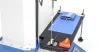
Coefficient of Friction (COF) Testing
Coefficient of Friction (COF) testing measures the static and kinetic friction values to help determine the quality of the final product.