Search results
851
Event
Medical Devices – Syringe & Needle Testing Fundamentals
Vial sealing is a critical step in the process of ‘fill and finish’ operations for vaccines and medications, as it defines the seal quality of the final product, ensuring sterility and preventing leakage.
852
[Page extract]
BS 6079-1
BS 6079-1 aims to help people and organizations achieve a desired outcome of a project efficiently and effectively, as well as to contribute to the learning within projects and so continually improve their organization’s project management capability.
853
[Page extract]
BS EN ISO 2060
Cancels and replaces the first edition (1972). Specifies a method for the determination of the linear density of all types of yarn in package form. Includes seven optional procedures based on different methods of conditioning and preparation.
854
[Page extract]
BS EN 12445
This standard specifies the test methods to be applied to a power operated door to demonstrate compliance with the requirements specidied in EN 12453: 2000 in particular it specifies the method of measuring the forces developed by a power operated door.
855
Event
Tensile Testing for Wiring Harness Connections
The only way of really knowing the strength of a crimped terminal is to pull it. This can reveal production problems, where strand nicks, incorrect crimp height, or effects from changes in terminal supply, may not be clearly apparent.
856

Event
Wine & Spirits: Pull Tab & Twist Cap Testing
Canned wine and seltzer drinks have a clear upside that makes their popularity soar: Convenience. As well as being lighter to carry, less potentially fragile, eliminating the corkscrew, and even a glass makes it ideal for social gatherings.
857
[Page extract]
ASTM D6049-03
This test method is capable of measuring and characterizing the rheological behavior (viscosity and elasticity) of unvulcanized raw rubbers and rubber compounds, relating to the macro structure of rubber polymers (average molecular weight, molecular wei
858
[Page extract]
ASTM F2923
This specification establishes requirements and test methods for specified elements and certain mechanical hazards in children's jewelry.
859
[Page extract]
ASTM D3469
These test methods measure the downward forces during the disengagement of lug-style caps from their respective containers. The methods measure the maximum torque developed while the cap is further disengaged by turning of the container.
860
[Page extract]
ASTM D4917-90
1.1 This test method describes a horizontal plane procedure for the determination of the coefficient of static and kinetic friction of paper measured when sliding against itself.
861
Event
Tensile Testing for Wiring Harness Connections
The only way of really knowing the strength of a crimped terminal is to pull it. This can reveal production problems, where strand nicks, incorrect crimp height, or effects from changes in terminal supply, may not be clearly apparent.
862
[Page extract]
BS EN ISO 19011:2011
Provides the fundamental knowledge needed for auditing management systems and has been expanded to reflect modern thinking and the intricacies of auditing multiple management system standards (MSS).
863
[Page extract]
ASTM E1012-12e1
It has been shown that bending stresses that inadvertently occur due to misalignment between the applied force and the specimen axes during the application of tensile and compressive forces can affect the test results.
864

Event
Fundamentals of Adhesion (Peel) Testing
There is a reason people reach for Duct Tape as a fix for almost everything – Adhesion Strength. From busted pipes to ripped furniture, the preference for a solution that “does not easily peel off” is the guiding principle for manufactures.
865
[Page extract]
ASTM F2258-05
This test method is intended to provide a means for comparison of the adhesive strengths of tissue adhesives intended for use as surgical adhesives or sealants, or both, on soft tissue.
866
[Page extract]
BS EN ISO 80369-1
BS EN ISO 80369 “Small-bore connectors for liquids and gases in healthcare applications. Connectors for intravascular or hypodermic applications”.
This standard replaces BS EN ISO 594-1: 1986, BS EN 20594-1:1994, and BS EN 1707:1997.
867

Event
Cap Closure and Removal Torque Testing
The primary objective for measuring and analyzing the torque characteristics of a container cap is to accurately determine not only the quality of the part or process, but also the root cause of a wide variety of defects.
868

[Page extract]
Chemicals & Adhesives
Chemicals, adhesives and coatings play a crucial role in almost every area of our lives, so testing their performance is vital.
869
[Page extract]
ASTM D5766 / D5766-M
ASTM D5766 is a test method to determine the open-hole tensile strength of multidirectional polymer matrix composite laminates reinforced by high-modulus fibres.
870
[Page extract]
ASTM F2999
1.1 This specification establishes requirements and test methods for specified elements and for certain mechanical hazards in adult jewelry.
872
[Page extract]
ASTM F88/F88M
ASTM F88 test method covers the measurement of the strength of seals in flexible barrier materials. Seal strength is the tensile strength of the seal at ambient temperature.
873
[Page extract]
ASTM B571
This practice covers simple, qualitative tests for evaluating the adhesion of metallic coatings on various substances.
874
[Page extract]
ASTM D2659
ASTM D2659 determines the mechanical properties of blown thermoplastic containers under columnar crush conditions at a steady rate of compression. Any container, whether blown commercially or in the laboratory, may be used as the test specimen.
875
Event
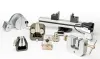
Webinar: Essentials of Grip & Fixture Selection in Force & Torque Testing
For a test to work, the test system needs to properly interface with its specimen.