Search results
1277
[Page extract]
Torque testing methods
Programmable torque testers
Motorised torque testers allow engineers to define torque profiles, control rotational speed, and capture the complete torque-tension curve.
1278
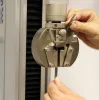
Event
Essentials of GRIP & FIXTURE Selection in Force & Torque Testing Webinar
When physically testing a material or component, the ability to apply load to a test specimen is important—but having the ability to apply that load correctly is just as crucial.
1279
[Page extract]
Applications in demanding sectors
The strip method is used wherever fabric integrity under load is critical:
1280
[Page extract]
Introduction to friction and its importance
Friction is the resistive force that occurs when two surfaces interact. It plays a fundamental role in engineering and manufacturing.
1281

Case study
Railcar spring testing
Requirement
Seoul Metropolitan Railway Transit Corporation required a system for testing a variety of springs in their electric railcars. The springs range in size from 3mm to 100 mm in diameter.
1282
[Page extract]
ASTM D1578
Significance and Use
Test Method D1578 for testing any spun yarn for breaking strength is considered satisfactory for acceptance testing of commercial shipments since the method has been used extensively in the trade.
1283

Event
Tensile Testing for Wiring Harness Connections
The only way of really knowing the strength of a crimped terminal is to pull it. This can reveal production problems, where strand nicks, incorrect crimp height, or effects from changes in terminal supply, may not be clearly apparent.
1284
[Page extract]
Speak to an expert
Tensile testing and elongation at break measurement are essential for material performance evaluation, product development, and quality assurance.
1285
[Page extract]
Step-by-step guide to conducting the ring crush test
Prepare the sample
Cut samples to the required size specified by the relevant standard, typically corresponding to a circumference of 152 mm. Condition the samples at the specified temperature and humidity.
1286
[Page extract]
Types of calculations handled
Mecmesin’s VectorPro software supports a wide range of test calculations, automatically derived from mechanical testing data:
1287
[Page extract]
Mechanical properties and accuracy considerations
Tensile testing via the strip method reveals mechanical properties that determine how fabrics perform in use.
1288
[Page extract]
Introduction to tear resistance testing
Tear resistance testing is a critical mechanical property assessment for flexible materials such as plastics, elastomers, coated fabrics and textiles.
1289
[Page extract]
Magnets and solenoids
Solenoids, a type of electromagnet generating a uniform magnetic field when an electric current is passed through it, have applications in many different types of industries.
1290
[Page extract]
What we do
From easy-to-use, hand-held force and torque gauges to software-controlled tensile testers and torque systems, we have the solution for your tension, compression and torque testing requirements.
1291
[Page extract]
BS EN ISO 844
ISO 844 specifies a method of determining a) the compressive strength and corresponding relative deformation, or b) the compressive stress at 10 % relative deformation, and c) when desired, the compressive modulus of rigid cellular plastics.
1292
[Page extract]
Why is top-load testing important?
Top-load testing plays a critical role in packaging design, quality assurance and compliance. It helps to:
1293
[Page extract]
Speak to an Expert
Corrugated medium testing, and particularly the flat crush test under TAPPI T 809, is essential for ensuring packaging strength, reliability, and compliance.
1294
[Page extract]
What is peel testing
A peel test measures the force needed to separate two bonded materials, usually by applying force at a set angle until the adhesive bond fails.
1295
[Page extract]
Introduction to penetration and puncture resistance testing
Penetration and puncture resistance testing are essential for evaluating how well a material can withstand force from sharp, pointed, or blunt objects.
1296
[Page extract]
Medical devices and aids
Medical device manufacturers operate in one of the world’s most competitive and highly-regulated industries, where patient safety is critical.
1297
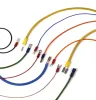
Event
Tensile Testing for Wiring Harness Connections
The only way of really knowing the strength of a crimped terminal is to pull it. This can reveal production problems, where strand nicks, incorrect crimp height, or effects from changes in terminal supply, may not be clearly apparent.
1298
[Page extract]
Introduction to compressive strength testing
Compressive strength testing is essential for evaluating the ability of materials to withstand axial loads, which are forces that push or pull them.
1299
[Page extract]
Grab method vs strip method
Compared with the strip method (as defined by ISO 13934-1), which grips the full width of the fabric, the grab method
1300
[Page extract]
BS EN ISO 205
Adhesives. Wood adhesives for non-structural applications. Determination of tensile shear strength of lap joints.