Search results
776
Accessory
Small Parallel Grip, 500 N, 10-32 UNF
432-394
Small Parallel Grips are designed for tensile testing of small flat components and materials below 500N.
A floating ball screw attachment ensures central loading during tensile testing and wing screws are used to quickly position the jaws.
Jaw faces…
777
Accessory
1/2" upper chuck assembly for use on Helixa sensors (3 N.m & 6 N.m only)
432-617
A standard self-centering 3-jaw chuck with key.
It has a maximum ½" (12.7 mm) opening and is connected to the Helixa torque sensor via an adaptor with female ⅜" square hole.
Used to secure a variety of test specimens for torque applications of 1.5 - 10…
778
Accessory
Coefficient of Friction (COF) kit to ISO 15359 for FPT-H1
432-639
Integrated kit for use on the FPT-H1 Friction Tester to enable paper and card coefficient of friction testing to ISO 15359.
Comprises:
- a neoprene-faced sled with magnetic grips
- servo-assisted device for raising and lowering of friction sled
- guide…
779
Accessory
Cable Cam grip for CrimpTest-1 kN
432-660
Cable Cam Grip for CrimpTest-1 Tester (supplied as standard with the Tester)
The Cable Cam Grip is designed for holding insulated cables and wire when tensile testing the pull strength of terminals up to 1 kN.
The cable is secured by the serrated cam,…
780
Accessory
Compression Plate, Self-levelling, Hardened & Ground, 50 mm, 10-32 UNF
432-349
Self-levelling compression plates are ideal for general compression testing on a range of materials and finished products. Self-levelling allows parallelism to be set for those applications where it is critical to accurately measure the deformation of a…
781
Accessory
Heavy-duty Vice Grip - Single Action, 10 kN, QC-20 fitting
Mec154-10
MEC 154-10 (body only - aluminium):
A Single-action Heavy-duty Vice Grip allowing one jaw to be manually set in a position to align a test specimen around the central axis. The other jaw is freely adjustable to mechanically clamp the specimen in place…
782
Accessory
Trolley pushing fixture, 1 kN
432-405
The Trolley Pushing Fixture has been designed to attach to trolleys and wheelie bins, so that manual handling measurements can be made easily. Typically used with a force gauge grip handle.
783
Accessory
Dovetail Bracket for AFG or BFG
432-427
The dovetail bracket is used for mounting the Advanced Force Gauge (AFG) and Basic Force Gauge (BFG) to test stands. It allows the operator to precisely align the gauge on the stand. Supplied with fixing screws.
Note: maximum load 2500 N
784
Accessory
Large Single-action Vice Grip, rubber-faced, 2 kN, QC-20 fitting
432-267-V01
A Large Single-action Vice Grip featuring one fixed jaw and one jaw as freely adjustable to mechanically clamp the specimen in place.
Rated to 2 kN in tension with rubber-faced jaws of 78mm wide x 28mm high having an opening of 0-9mm. Provides excellent…
785
Accessory
Floating Peel Jig (ISO 10373-1), 500 N, 10-32 UNF
432-413
The Floating Peel Jig is used to test the peel strength between adhesive layers of flat, rigid samples such as credit cards.
A portion of the top layer is placed between the rollers and held in an upper grip (order separately). As load is applied the…
786

Software
Vector OS (VFG/VFTI)
Vector OS
Our touchscreen instruments are powered by Vector OS, Mecmesin's technology platform for its latest force and torque test equipment. It delivers intuitive and customisable user interfaces, as well as advanced data acquisition and analysis.
To…
787
Accessory
Small Pinch Grip, 200 N, 10-32 UNF
432-280
Pinch grips are lightweight miniature vice grips, which use a hinge action to clamp a sample and a wing nut to tighten the jaw face.
Each 10 mm x 10 mm jaw face has a slight groove to help to hold the sample securely, yet avoid inducing a break within…
788
Accessory
25 mm/50 mm Grab Test Textile Fixture, 500 N, 10-32 UNF
432-323
The 'Grab Test' Textile Fixture has jaws of 25mm…
789
Accessory
Medium Vice Grip - Single Action, 2 kN, 20 mm opening, QC-20 fitting
Mec240k-S20
MEC 240k-S20 (body only) :
A Medium Single-action Vice Grip allowing one jaw to be manually set in a position to align a test specimen around the central axis. The other jaw is freely adjustable to mechanically clamp the specimen in place.
Rated to 2…
790
[Page extract]
Understanding TAPPI T 809 standard
TAPPI T 809 is an internationally recognised method for determining the flat crush resistance of corrugated medium.
791
[Page extract]
Testing standards and guidelines
Tension and compression tests are governed by international standards that ensure comparability and regulatory compliance:
792
[Page extract]
Standards and compliance
ASTM D2063 defines methods for determining application and r
793
[Page extract]
Essential standards for pull-off and pull-out testing
International standards provide consistent methods and equipment requirements for these tests:
794
[Page extract]
Standards and compliance
International standards ensure penetration and puncture testing is performed consistently for reliable and comparable results.
Key examples include:
795
[Page extract]
Standards and compliance
International standards ensure penetration and puncture testing is performed consistently for reliable and comparable results.
Key examples include:
796
[Page extract]
Standards and regulations in shear testing
Several industry standards and protocols govern food shear testing, ensuring repeatable results and regulatory compliance. Examples include:
797
[Page extract]
Standards and best practices
BS EN ISO 8670-2 specifies methods for testing pressurised containers, including procedures for determining the pressure at which a container fails. It ensures testing is consistent, repeatable, and conducted safely.
798
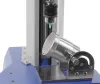
Event
Needle Sharpness & Puncture Resistance Testing
Hypodermic needles are tested to determine how their design influences the ease of insertion into the skin in order to prevent patient pain and skin trauma.
799
[Page extract]
PSTC 101
These methods cover the measurement of the peel adhesion of pressure sensitive tapes.
800

Event
Tensile Testing: Basics, Tips and Trends
Have you ever wondered if the seatbelt in your vehicle is strong enough to restrain you in a collision? How about the average person pulling the cork out of a wine bottle?